
Introduction
Posture, defined as the body’s alignment and positioning relative to gravity [1, 2], is fundamental to physical health, particularly for individuals engaged in prolonged or repetitive activities. Within this context, music students represent a vulnerable subgroup. Musical training requires extended practice in constrained, static, or asymmetrical positions, which increases the risk of postural imbalances and musculoskeletal disorders (MSDs) [3]. In recent years, growing empirical attention has been directed toward the relationship between musical performance and musculoskeletal health, highlighting not only biomechanical risks but also the impact on performance quality, psychological well-being, and long-term career sustainability [4].
Musicians, particularly students enrolled in intensive university training programs, often begin their musical education in adolescence or even childhood. This period overlaps with critical stages of physical development, rendering them more vulnerable to the long-term consequences of poor posture, including postural imbalances and chronic pain [2, 5]. Research indicates that more than 60% of conservatory students demonstrate postural imbalances, a prevalence significantly higher (p < 0.01) than that observed in general student populations [6]. The risk of inadequate posture is further elevated when playing asymmetrical instruments such as the violin or guitar [7]. These compounding effects underscore the urgent need for early preventive interventions in music students [2].
Biomechanically, posture is not a static concept but rather a dynamic equilibrium sustained by complex neuromuscular systems. Instrumental practice, which frequently requires fine motor control within fixed positions, can disrupt this balance [2, 8]. Even outside performance contexts, instrumentalists exhibit altered postural control compared with non-musicians, reflecting long-term neuromuscular adaptations to their training [8, 9]. Such dysfunction is evident in the weight-bearing asymmetries, increased postural sway, and compensatory strategies that place additional strain on specific musculo-skeletal regions.
The consequences of inadequate postural habits extend beyond musculoskeletal pain, affecting performance quality, musical expressivity, and even respiratory function [10]. Specific postural behaviours, particularly those involving head and torso alignment, have been shown to influence tone quality and dynamic control in cellists, illustrating the close relationship between physical alignment and acoustic outcomes [11]. Excessive tension or misalignment can provoke compensatory movements that restrict expressive nuance and compromise technical precision.
A significant proportion of performing arts students, particularly those studying music, experience playing-related musculoskeletal disorders (PRMDs) (p < 0.01) [12]. More than 86% of professional musicians report such disorders during their careers, with many music students already exhibiting early symptoms [13]. PRMDs most commonly affect the neck, shoulders, upper limbs, and back, with the severity often increasing as students advance through intensive training programs. Short-term e-learning interventions focused on posture have been shown to significantly reduce musculo-skeletal pain and improve postural habits among adolescent music students (p < 0.01) [14].
There is growing evidence supporting the integration of posture education into the early stages of music training [2]. Conservatory students who received instruction in posture, warm-up techniques, and injury prevention demonstrated significantly improved body awareness (p < 0.01) and reported a 78% reduction in injury rates over the course of one academic year [15]. Nevertheless, formal training in physical health, including posture, remains largely absent from music curriculums. Posture is still too often regarded as peripheral to performance technique rather than as an integral component of it.
Environmental and behavioural factors also play a critical role in shaping posture among performing arts students. Prolonged sedentary behaviour, excessive mobile device use, and high academic demands contribute to the development of spinal deformities such as scoliosis, kyphosis, and lordosis [2, 16]. Gender and instrument type further influence these risks; for instance, violinists and pianists display distinct postural asymmetries that require targeted ergonomic interventions [11]. Behavioural strategies, such as heightened awareness and regular stretching, have been shown to significantly reduce these risks (p < 0.01) [17]. Novel training approaches like mini-trampoline interventions have demonstrated promising results in reducing lower-limb asymmetries and enhancing neuromuscular coordination, which are critical for musicians who perform repetitive, asymmetric movements [18, 19].
Emerging technologies provide promising tools for assessing and enhancing posture. Postural monitoring systems such as force plates and three-dimensional motion capture are increasingly used to detect asymmetries and guide ergo-nomic adjustments [12]. These technologies generate objective data that supports personalised feedback and tailored training protocols. For example, the Posturo-Acoustic System integrates acoustic and proprioceptive cues to facilitate feed-forward posture control during training sessions [20].
Despite these advances, significant challenges remain. The absence of standardised protocols and validated measurement tools in musculoskeletal research on performing arts students continues to hinder cross-study comparisons and clinical translation [2, 13, 20]. Furthermore, the lack of long-term follow-up restricts the evaluation of sustained intervention effectiveness. Meaningful progress in this field will require interdisciplinary collaboration, drawing on expertise from physiotherapy, occupational health, and music pedagogy.
Recent developments in holistic preventive programs, such as the PRESTO trial, which combines biopsychosocial education with postural training, mark an important step toward evidence-based intervention strategies [21]. Embedding postural health within the core curriculum of music training, supported by validated interventions and tailored to the individual needs of students, remains essential [2, 14, 22]. As music institutions increasingly acknowledge the importance of musculoskeletal health, the integration of structured intervention programs of at least six weeks in duration has the potential to significantly enhance artistic performance (p < 0.01) and support long-term career sustainability. Building on this rationale, this study aimed at evaluating the effectiveness of a 6-week postural intervention program designed for undergraduate music students.
Subjects and methods
Participants
This study employed a quasi-experimental, 2-group pre-/ post-intervention design to evaluate the effects of a 6-week postural intervention program on posture in undergraduate music students enrolled in Performing Arts and Composition. The intervention was conducted over 6 weeks, from January 1 to February 10, and outcomes were compared between an intervention group and a non-intervention control group. The intervention consisted of 20-minute exercise sessions, delivered 3×/week, specifically tailored to address musculo-skeletal challenges common in performing arts disciplines [2].
The target population comprised 16 male undergraduate music students (100%) enrolled in the 1st and 3rd years of the Bachelor’s program in Performing Arts and Composition at the Academy of Arts in Banská Bystrica (Faculty of Performing Arts). Participants were recruited through combinations of convenience and purposive sampling to ensure demographic and academic homogeneity across the two groups [23]. Inclusion criteria required participants to be male, aged 18–23 years, enrolled in the elective course Prevention of the Musculoskeletal System 1-2, and free from any PRMDs or MSDs at the time of enrolment [24]. Additional recruitment was conducted via institutional email invitations to secure an adequate sample size [2].
Ten participants (62.50%) were assigned to the experimental group (age: 20.40 ± 1.20 years; weight: 74.80 ± 4.20 kg; height: 178.60 ± 4.80 cm), while the remaining 6 participants (37.50%) were allocated to the control group (age: 20.80 ± 0.60 years; weight: 72.40 ± 2.80 kg; height: 174.40 ± 2.20 cm) (Table 1). Randomisation was not employed due to the small sample size (n = 16) [25] and scheduling constraints; however, the participants were carefully matched based on age and year of study to ensure pre-intervention equivalence between groups.
Although the sample represented subsets of the total population of 48 eligible male undergraduate music students, it reflected a high participation rate under real-world conditions. An a priori power analysis, assuming a medium effect size (d = 0.5), 80% power, and a significance level of 0.05, indicated that approximately 34 participants would be required to detect meaningful effects. While the present sample (n = 16) fell below this threshold, the study provides valuable preliminary insights and establishes a foundation for future large-scale investigations.
Assessments, measures, and procedures
To evaluate the effectiveness of a 6-week postural intervention program designed for undergraduate music students, a quasi-experimental pre-/post-intervention design was employed. Of the total sample, 10 participants (62.50%) were assigned to the experimental group and completed the intervention, while the remaining 6 participants (37.50%) formed the control group and received no intervention. This quasi-experimental design enabled comparisons between groups to assess changes in defined musculoskeletal outcomes attributed to the 6-week program.
The intervention was implemented over 6 weeks ( t), from January 1 to February 10, 2025, and consisted of 3 supervised sessions/week (Mondays, Wednesdays, and Fridays), each lasting 20 min. All sessions followed a structured format and were conducted under the direct supervision of the research team. Qualified instructors (the study authors) ensured correct execution of exercises and provided individualised feedback as required.
The participants in the experimental group received a detailed orientation outlining the objectives, procedures, and potential risks and benefits of the intervention to support adherence and reinforce its musculoskeletal health focus. Postural assessments were conducted at 2 points: pre-intervention (week 1, January 1) and post-intervention (week 6, February 10). This repeated-measures design enabled both within-subject and between-group comparisons, providing insights into the effectiveness of the intervention (Table 2).
Table 2
6-week intervention program – overview
The 6-week postural intervention program was implemented for 10 participants (62.50%) to address postural imbalances and musculoskeletal discomfort associated with prolonged asymmetrical playing positions. The program consisted of three 20-minute sessions/week, focusing on postural awareness and mobility, core engagement, upper-body alignment, and related components (Table 2). Each session was carefully structured to maximise the effectiveness within the limited timeframe and was supervised to ensure correct execution and provide individualised feedback. This frequency and duration of 20 minutes, 3×/week is consistently supported in the literature as effective for improving posture, reducing musculoskeletal pain, enhancing neuromuscular control, and alleviating psychological stress. As such, the selected dosage represents both a time-efficient and evidence-based approach for music students and other at-risk populations [26–30].
– Warm-up (2 min)
Starts with breathing exercises and self-evaluation of posture to promote awareness.
– Core block (6 min)
Focuses on building the core with exercises such as dead bugs, glute bridges, and bird-dogs, which help to maintain spinal alignment.
– Postural correctives (6 min)
Involves drills (target) such as wall slides, chin retractions, and seat alignment resets to strengthen/correct postural muscles.
– Functional movements (4 min)
Incorporates dynamic balance drills and playing posture simulations to reinforce posture in real-life musical scenarios.
– Cool-down (2 min)
Ends with breathing exercises and self-evaluation of posture to promote awareness (Appendix).
Table 3
Ditferences in posture between 2 dependent samples – Klein and Thomas/Mayer tool
All 10 participants (62.50%) in the intervention group informed the researchers of any musculoskeletal issues or discomfort, including potential pain, and were monitored throughout the sessions for signs of fatigue such as trembling or loss of control. A group-based format was chosen for program delivery due to its cost-effectiveness, the benefits of peer support, and its potential to enhance participant engagement [31, 32]. Posture was evaluated using the standardised tool developed by Klein and Thomas/Mayer [33]. Assessments were conducted at 2 points: week 1 (January 1) and week 6 (February 10, 2025). The tool focused on 5 anatomical segments:
All 5 segments were rated on a 1–4 numerical scale, with lower scores reflecting better posture and higher scores indicating greater deviation from the ideal. The postural score was calculated as the aggregate of all segmental ratings, providing composite measures of postural alignment:
Statistical analysis
The available data from the 16 (100%) participants enrolled in Performing Arts and Composition was organised and presented in a structured database format [36]. Because of the small number (n) of undergraduate music students (n = 16, 100%), the authors employed non-parametric tests for comparisons (within- and between-groups). The Kolmogorov– Smirnov test (KS) indicated that the variables did not follow normal distributions; therefore, the Wilcoxon test (W) was employed for intragroup (within) comparisons across preand post-interventions. The Mann–Whitney U-test (MWU) was employed for intergroup (between) comparisons between the experimental group (n = 10, 62.50%) and the control group (n = 6, 37.50%). The significance level (p) was set at 0.05 and 0.01, with confidence intervals of 95%, and the effect size (r) was calculated for W and MWU by dividing the z value by the n (total) of observations [37–40]. Mean (group) values ± standard deviations (SD) were employed to summarise the descriptive data [41]. The statistical analysis was carried out using IBM SPSS Version 27.
Table 4
Ditferences of posture between 2 independent samples – Klein and Thomas/Mayer tool
Results
The results of this study demonstrated statistically significant improvements in postural alignment among participants in the experimental group following the 6-week intervention program. Within-group comparisons using the Wilcoxon test revealed significant reductions in postural deviations across 4 of the 5 anatomical parameters. Specifically, head/neck alignment improved from pre-intervention means of 2.60 ± 0.84 to post-intervention means of 1.50 ± 0.52 [Z = 2.82, p < 0.01, r = 0.62, 95% CI (0.39, 1.81)]. Abdomen/pelvis alignment also showed significant improvement, decreasing from 2.80 ± 0.42 to 1.70 ± 0.68 [Z = 2.80, p < 0.01, r = 0.60, 95% CI (0.53, 1.67)]. The curvature of the spine exhibited the greatest change, improving from 2.30 ± 0.48 to 1.30 ± 0.48 (Z = 3.16, p < 0.01, r = 0.70, 95% CI [0.51, 1.49]). Shoulders/scapulae also showed significant decreases in postural deviation, with scores dropping from 2.00 ± 0.66 to 1.20 ± 0.42 [Z = 2.84, p < 0.01, r = 0.64, 95% CI (0.24, 1.36)] (Table 3, Figure 1).
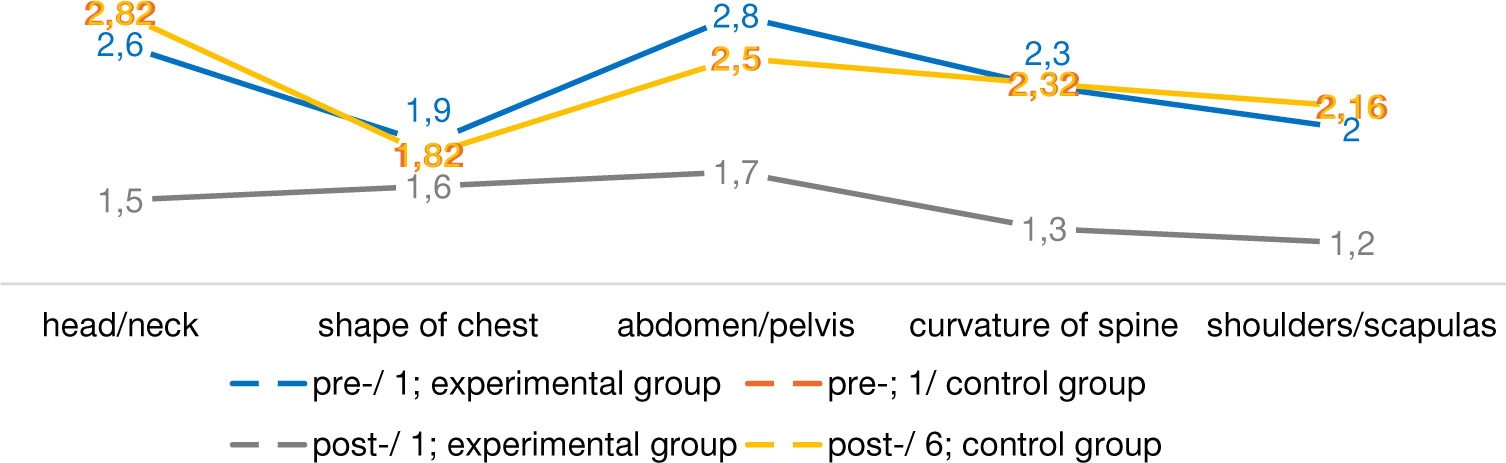
In contrast, no significant changes were observed in the shape of the chest, which decreased slightly from 1.90 ± 0.74 to 1.60 ± 0.70, but this was not statistically significant [Z = 1.74, p > 0.05, r = 0.38, 95% CI (−0.43, 1.03)]. Overall, the postural score in the experimental group improved markedly from means of 11.60 ± 1.72 pre-intervention to 7.30 ± 1.42 post-intervention [Z = 2.84, p < 0.01, r = 0.64, 95% CI (2.71, 5.89)], indicating shifts from ‘bad’ to ‘good’ posture according to the Klein and Thomas/Mayer tool.
No changes were detected within the control group, where all pre- and post-intervention scores remained identical across all 5 anatomical segments and in the overall postural score. For instance, head/neck alignment remained at 2.82 ± 0.40, and the overall postural score stayed constant at 11.66 ± 1.64, with no statistically significant differences (p > 0.05) observed in any domain.
Between-group comparisons using the Mann–Whitney U-test confirmed that there were no significant differences between the experimental and control groups at baseline (week 1) across any of the anatomical parameters, with p values all greater than 0.05 and effect sizes ranging from r = −0.02 to −0.30. For example, the baseline postural scores were 11.60 ± 1.72 for the experimental group and 11.66 ± 1.64 for the control group [Z = −0.12, p > 0.05, r = −0.02, 95% CI [−1.62, 1.50]) (Table 4, Figure 1).
However, significant between-group differences emerged at post-intervention (week 6) across all parameters except for the shape of the chest. Head/neck alignment differed significantly, with post-intervention scores of 1.50 ± 0.52 in the experimental group versus 2.82 ± 0.40 in the control group [Z = −3.16, p < 0.01, r = −0.80, 95% CI [−1.76, −0.88)]. Abdomen/pelvis alignment was significantly better in the experimental group (1.70 ± 0.68) than in the control group (2.50 ± 0.54) [Z = −2.12, p < 0.05, r = −0.54, 95% CI (−1.39, −0.21)]. Similarly, the curvature of the spine showed marked improvement in the intervention group compared to the control [1.30 ± 0.48 vs. 2.32 ± 0.52; Z = −2.86, p < 0.01, r = −0.72, 95% CI (−1.50, −0.54)], and the shoulders/scapulae were significantly better aligned [1.20 ± 0.42 vs. 2.16 ± 0.76; Z = −2.56, p < 0.05, r = −0.64, 95% CI (−1.57, −0.35)].
The total postural score at post-intervention further confirmed the efficacy of the intervention, with the experimental group showing significantly lower (i.e., better) scores (7.30 ± 1.42) than the control group (11.66 ± 1.64) [Z = −3.14, p < 0.01, r = −0.78, 95% CI (−5.92, −2.80)]. The only parameter where no between-group difference was observed post-intervention was the shape of the chest [1.60 ± 0.70 vs. 1.82 ± 0.84; Z = −0.66, p > 0.05, r = −0.20, 95% CI (−0.98, 0.54)].
Discussion
This study evaluated the effects of a 6-week postural intervention program on posture in music students. The results demonstrated that the participants in the experimental group (n = 10, 62.50%) experienced significant improvements (p < 0.01; p < 0.05) across 4 of 5 anatomical parameters: head/neck, abdomen/pelvis, curvature of the spine, and shoulders/scapulae. In contrast, the control group (n = 6, 37.50%) showed no meaningful changes. Beyond statistical significance, these findings also carry clinical relevance, indicating that the improvements were not only measurable but also practically meaningful. The reduction in overall postural scores from 11.60 to 7.30 reflects shifts from ‘bad’ to ‘good’ posture, an outcome highly relevant for music students at risk of musculoskeletal disorders. Improvements in the curvature of the spine and shoulder alignment, 2 of the most common areas of strain in musicians, are particularly important. The effect sizes (r = 0.60–0.70) confirm the magnitude of these benefits. Taken together, the intervention appears not only statistically robust but also clinically impactful, offering feasible and replicable approaches for enhancing postural health in music education contexts.
These results reinforce the importance of targeted, short-term interventions for music students, who are particularly susceptible to musculoskeletal disorders due to the demands of prolonged, asymmetrical instrumental practice [14, 22]. Curvature of the spine showed the most pronounced improvements (2.30 ± 0.48 to 1.30 ± 0.48; Z = 3.16, p < 0.01, r = 0.70), followed by the shoulders/scapulae (2.00 ± 0.66 to 1.20 ± 0.42; Z = 2.84, p < 0.01, r = 0.64). These outcomes suggest that the intervention enhanced not only static posture but also addressed dynamic musculoskeletal imbalances linked to compensatory strategies in instrumental performance. This aligns with earlier research highlighting the benefits of core-s trengthening and alignment training for musicians [2, 17, 42], as well as research showing acute improvements in leg stiffness and reactive power through mini-trampoline-based training, which could represent an adjunct or future extension to postural rehabilitation in musicians [19].
The absence of significant improvements in the control group strengthens the causal link between the intervention and the observed benefits. Without structured guidance, music students seldom adopt compensatory strategies that mitigate musculoskeletal strain [2, 5–7, 43].
The only anatomical parameter without significant change was the chest (p > 0.05). This may indicate that 6 weeks is insufficient to achieve measurable improvements in thoracic alignment, or that the program lacked sufficient thorax-specific exercises. This finding is consistent with the literature [2, 42, 44], which highlights the inherent difficulty of thoracic realignment due to structural rigidity and the slower adaptability of ribcage musculature [7]. The thoracic region, anchored by the ribcage, is inherently less responsive to short-term interventions compared to more mobile segments such as the cervical spine or shoulders. Improvements in chest posture often require longer interventions, typically exceeding eight weeks, particularly in populations like musicians who have long-established postural habits. While this program effectively addressed global alignment, it did not include dedicated thoracic components such as extension drills, intercostal flexibility exercises, or diaphragmatic breathing techniques. These elements are essential for meaningful thoracic change. Interventions that incorporate such components, including yoga-based breathing or the Alexander Technique, have been shown to improve thoracic alignment but usually require 8–12 weeks to yield significant results [45].
The structure of the intervention, 3×/week, combining awareness, mobility, and integrative corrective exercises, was a key factor in producing significant improvements within a short period (p < 0.01; p < 0.05). Warm-ups centred on diaphragmatic breathing improved kinaesthetic awareness and prepared the neuromuscular system for corrective drills. Exercises such as wall slides and chin tucks mirrored established rehabilitation protocols that have proven effective in both clinical and performing arts contexts [1, 11, 14, 15, 45].
The brief yet structured format of each 20-minute session supports growing evidence that micro-interventions are both feasible and impactful, especially in time-constrained academic environments [46]. Delivering the program in a group-based format likely provided additional benefits, including peer reinforcement, increased motivation, and higher adherence, factors reported in similar educational and rehabilitative interventions [9, 47].
The postural improvements observed here align with research showing that posture is not merely a matter of musculoskeletal health but also significantly influences technical and artistic performance. Head and neck alignment directly affect tonal quality and expressivity in string players [10,12], indicating that improved physical alignment can enhance both functional health and musical quality, which is a compelling implication for educators [11].
A notable feature of this study was the reliance on the Klein and Thomas/Mayer tool, which rates posture across 5 anatomical segments. While this tool provided a stand-ardised and replicable framework, it is limited to static assessment. Future research should integrate more nuanced approaches, including dynamic methods such as 3-dimensional motion capture or pressure sensors, which are increasingly used in posture research involving musicians [4, 11, 13, 22, 47]. Such methods would enable a more comprehensive understanding of the relationship between posture and performance-related movement.
Despite its contributions, this study has several limitations. The small sample size (n = 16), though reflective of the specific inclusion criteria, limits the generalisability and fell short of the 34 participants estimated by the a priori power analysis. Randomisation was not feasible due to academic scheduling, and while the groups were matched for age and study year, potential selection bias cannot be excluded. Another limitation is the absence of long-term follow-up. Although the immediate improvements observed after 6 weeks are promising, the sustainability of these gains remains unknown. Prior research suggests that postural habits, especially in populations with ingrained movement patterns such as musicians, often regress without long-term reinforcement strategies. E-learning platforms have been found effective in improving postural education outcomes in music students, demonstrating feasibility for scalable, remote interventions [48]. Longitudinal tracking (e.g., 3- or 6-month follow-up) would be needed to confirm durability. The homogeneity of the sample, all male undergraduate students aged 18–23, controlled for certain variables but restricted insight into gender- or age-specific responses. The exclusive use of male participants notably limits the generalisability of the findings, particularly as musculoskeletal disorder prevalence, postural compensations, and responsiveness to interventions may differ significantly by gender. The literature indicates gender differences in musculoskeletal disorders and postural compensation strategies in music students [47–50], underscoring the need for more diverse samples in future investigations. A more inclusive sample that incorporates female and non- binary participants would allow for broader applicability of the results across music education populations and could reveal gender-specific responses to postural interventions. Furthermore, the study did not include any functional performance outcomes, such as playing-related measures (e.g., tone quality, technical accuracy, or endurance). While postural improvements were objectively measured, the absence of performance-linked metrics limits the applied relevance of the findings for music educators and performers. Future research should incorporate both musculoskeletal and performance- based indicators to better evaluate the practical impact of such interventions.
Conclusions
This study found that a 6-week postural intervention program significantly improved postural health in music students (p < 0.01; p < 0.05). The participants in the experimental group (n = 10, 62.50%) who completed 20-minute sessions 3×/week showed marked improvements across 4 of 5 anatomical parameters, head/neck, abdomen/pelvis, curvature of the spine, and shoulders/scapulae, shifting from ‘bad’ to ‘good’ posture as measured by the Klein and Thomas/Mayer tool. The control group (n = 6, 37.50%) showed no change, confirming the effectiveness of the intervention.
These findings support the integration of posture-focused education into music curricula through brief, evidence-based sessions that fit within academic schedules. Preventive training should begin early, be tailored to instrument-specific demands, and may be enhanced by wearable or digital feedback technologies.
Limitations include the small, homogeneous sample, lack of randomisation, and absence of long-term follow-up. Future studies with larger, more diverse cohorts and longitudinal tracking are needed to test the sustainability of the effects.
Embedding structured posture programs into conservatory and university training could help prevent musculoskeletal disorders, improve body awareness, and support both performance quality and career longevity in musicians.