
Introduction
The dynamic interactions between genetic, neurological, cognitive, emotional, and behavioural processes across the developmental lifespan are known as neurodevelopment. This dynamic process can be severely and persistently interrupted by any genetic or environmental risk, leading to neurodevelopmental disorders or disability. Children with neurodevelopmental delay (NDD) have a delay in two or more developmental milestones, such as gross/fine motor, speech/ language, social/personal, cognition, and daily living tasks. When a child is delayed in development, he or she will have trouble meeting developmental milestones compared to chronological peers [1, 2]. The pooled prevalence of NDD is 7.5 per 1000 children, but is higher for those with neurological disorders (11.3/1000). Population-based burden estimates calculated across five regions in India shows that for children between the ages of 2 and 9 years, one in eight have at least one NDDs with cerebral palsy (CP) with neuromotor impairment being the most common form, with a prevalence of 1.2–2.5 per 1,000 live births [3, 4].
Bladder and bowel dysfunction (BBD) is a prevalent condition in children that is probably underdiagnosed. Constipation and/or encopresis are the main bowel complaints that accompany a wide range of lower urinary tract symptoms (LUTS) that are referred to as BBD. Dysuria, urgency, frequency of urination, hesitation, incontinence during the day, enuresis, dribbling, straining, delay of voiding, and urine retention are among the symptoms of LUTS that are typical with BBD. Increased rectal faecal load generally has two effects on bladder emptying and/or storage: (i) mechanical compression, which decreases the capacity of the bladder and leads to increases in frequency; and (ii) modifying the physiological neuronal impulses of the bladder and pelvic floor muscles, leading to persistent bladder spasms, inadequate emptying, large post-void pee volumes, and a gradually waning urge to evacuate [5, 6].
According to the Diagnostic and Statistical Manual (DSM) V, if a child urinates repeatedly on the bed or clothes, whether intentionally or involuntarily, and this behaviour manifests twice weekly for at least 3 consecutive months, it is enuresis, which falls into two categories: primary and secondary. Primary enuresis occurs when a child cannot maintain continence until they are five years old. Secondary enuresis occurs when a child who has previously gained continence reverts to incontinence [7]. The most common problems these children encounter are encopresis, soiling, and constipation. Encopresis is characterised by rare bowel movements. Soiling is a small amount of stool that leaks and discolours the area. Constipation is slow bowel movements, encopresis or debris, abnormally large stools, restricted posture, and hard, often painful urination [8]. According to a report published by the International Children’s Continence Society, the rate of Nocturnal Enuresis (NE), Daytime Urinary Incontinence (DUI), and Faecal Incontinence (FI) in ADHD is 17.6%, 24.8%, and 13.2%, respectively, while in Autism Spectrum Disorder (ASD) the rate of NE ranges from 2% to 90%, DUI ranges from 13.3% to 55% and FI ranges from 2 to 76%, in intellectual disability, the rate of NE is 38.1%, DUI is 39% and FI is 30.5%, while in CP, the rate of DUI ranges from 8.8 to 40.8%, NE ranges from 6.5% to 25.5%, and FI is 39.2% [9–11].
For a child aged between 1.5 and 4 years, toilet training becomes an important point in their development, along with the family. It depends on various factors such as the development and maturation of the nervous system, along with pyramidal tract myelination, cooperation of the child, attitudes of the parents, and family expectations, which also influence the readiness of the child [12].
Learning how to urinate and defecate in a toilet at a certain age and time in a way that is socially acceptable is known as toilet training [13]. Developing toileting independence is a vital developmental milestone for a child, and a lack of toileting is a substantial obstacle to the quality of life for people with and without NDD [14]. The American Academy of Pediatrics states that a child’s physical and psychological development – which includes their capacity to sit, walk, comprehend, and listen to instructions – determines when toilet training should start. According to current recommendations, children who are typically developing should be prepared to start toilet training by the time they are 18 to 24 months old, and they should be able to use the restroom during the day by the time they are 3 to 4 years old [15].
As physical therapists concentrate primarily on gross motor function development in children with NDD, therapists encounter toilet training issues in routine practice, so working on the trunk and pelvic floor muscles may enhance positive toilet training in them. Hence, the study aimed to determine the effectiveness of the Azrin-Foxx method and the child-oriented method, treated in the form of exercises that will help in training children, if children with NDD can be helped in their toilet training, and if they can be successfully toilet trained in 4 weeks of intervention along with the routine treatment.
Subjects and methods
Study design, setting and sample size
The study was a randomised controlled trial. The trail was designed with 90% power and two-sided 5% significance, and the sample size was 15 with an effect size of 0.5 [16].
Patients
Inclusion criteria were children aged 5–10 years of either gender with a confirmed diagnosis of NDD by a paediatrician or a medical professional, who had repeated passage of urine or faeces in inappropriate places, whether intentional or unintentional, for at least 3 consecutive months and who were able to follow simple commands such as pointing to their nose, or hair, and giving or taking.
Exclusion criteria were children having severe mental retardation when evaluated by a clinical psychologist based on the Vineland Social Maturity Scale, having an acute infection that led to bladder and bowel dysfunction, and who were on a catheter, colostomy bag or medications.
The samples were collected from the Paediatric Physiotherapy OPD in a tertiary-level hospital and special schools for disabled children in urban areas of Karnataka, India. A total of 30 children were included in the study based on the inclusion and exclusion criteria, as mentioned in the CONSORT chart in Figure 1. The parents were informed about the study; the demographic data were collected, and the participants were asked to fill out a bowel diary for 1 week. The diary contained 5 components: number of days the child performed a bowel movement, number of days the child performed a bowel movement outside the toilet, consistency of stool (Bristol Stool Chart was used), timing of the bowel movement, and medications used. Based on the bowel diary, information was collected about the days the child had a bowel movement and also the bowel movements done outside the toilet. Children were also evaluated on the Templeton Scale of Continence, Wingspread Scheme, and Childhood Bladder and Bowel Dysfunction Questionnaire.
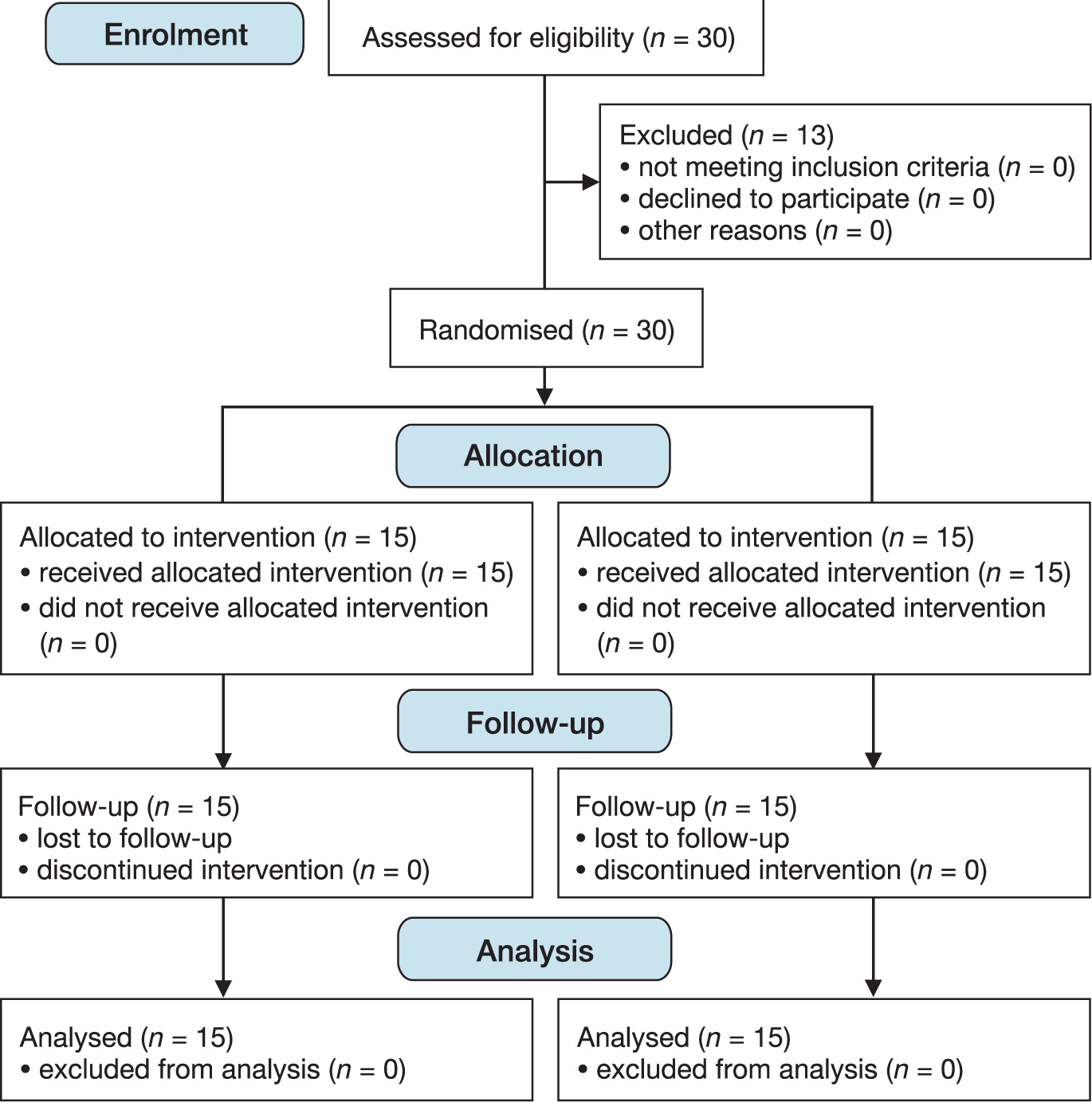
Children were randomly divided into two groups, A and B, using a block randomisation method at a ratio of 1:1. Both group A and B were given treatment 5 days a week for 4 weeks/ 1 month, which was administered daily.
Intervention
The 40-minute protocol consisted of
Group A: child-oriented method group
Child-oriented method of toilet training
The parents were asked to introduce the potty chair as the child’s own chair, and the child was allowed to get used to it and was told to think of it as their parents’ toilet. For some days, the child was made to sit on it fully clothed for 10 min, then after one or two weeks, the child was made to sit on it while wearing a diaper. After some days, the parents were asked to make the child sit on the potty until they wanted to sit. Then they were asked to teach the child about the toilet, like where the bowel movements go. After the child understood the commands, they were asked to go to the potty several times a day. Next, the child was asked to sit without a diaper and to use the toilet nearby, and was encouraged to use it independently. The child was praised whenever they did it on their own, and periodic reminders were also given. After this, the child was taught how to raise and lower their pants, which will help them in independent toilet training [17].
Exercises consisted of:
Stretching exercises for the calf muscles, hamstrings, and hip adductors.
Exercises for the abdominal muscles such as sit-ups [18].
Pelvic floor muscle exercises where the child was asked to lie down on a mat and a small toy was put on their abdomen. They were then asked to contract their abdomen to make the toy move towards them [19].
Group B: Azrin-Foxx method group
Azrin-Foxx method of toilet training
The child was trained to identify wet pants from dry pants and was rewarded whenever the child identified them correctly. This check was done every 10 min, and the mothers or caregivers were asked to give the child as much water as the child wanted to drink to create a strong desire for the child to go the toilet and urinate, which was used as a positive reinforcement. The child was asked to walk to the toilet and lower their pants and sit for some time, then to come back. After the child became comfortable with this, the number of trials was increased and the frequency was decreased as the child acquired the skill. The dry pants check was continued, and at first the child was made to sit for 10 min, and after the child understood the method, the sitting time was reduced. After 2 weeks, the child was told to ‘go to the potty’ whether they have to go to the potty or not, and questions like ‘are your pants dry?’ were also asked, the parents or caregivers asked the child questions such as ‘where should you potty?’. After this training, the mothers were asked to conduct dry pants checks at mealtimes, naptimes, and bedtimes, If there was any accident, the mothers were asked to reprimand the child and ask the child to change the diaper or clothes by themselves, but no reminders were given [20].
The exercises were the same as in group A [18, 19]
In both groups, the parents were asked to repeat the same protocol at home twice a day along with the potty-training method.
Outcome measures
The outcome measures for the study were the bowel diary, Wingspread Scheme, Childhood Bladder and Bowel Dysfunction Questionnaire (CBBDQ), and Templeton Scale of Continence.
The number of days the child performed a bowel movement outside the toilet and the days without soiling were used to evaluate the bowel diary.
The Wingspread Scheme is a clinical tool used to determine the degree of constipation and continence. The four primary categories of continence grades are as follows: clean receives one point, smearing receives two, intermittent soiling receives three, and continual soiling receives four. The consequences of faecal build-up are recorded as follows: constipation is awarded one point when there is no constipation, two points for sometimes constipation, and three points for constipated [21].
In the Templeton Scale of Incontinence, points are awarded for the following: the degree of knowledge of an imminent bowel movement, the incidence of an unintentional bowel movement, the necessity for additional liners or underwear, social issues, physical activity restriction, and diaper rashes. Children who have good continence receive one point, those who have fair continence receive two points, and those who have bad continence receive three points [21].
The CBBDQ scale is divided into two parts: one for bladder and one for bowel symptoms. Scored using a Likert scale, scores range from 0 meaning never to 4 meaning almost daily or daily. The scale is scored from zero to 72. A score over 11 indicates that the child may have BBD [22].
All the outcome measures were taken pre- and post-intervention.
Results
As per the inclusion and exclusion criteria, a total of 30 participants were included in the study, whose cognitive assessments were done by a clinical psychologist using the Vineland Social Maturity Scale. Children with varied intellectual disabilities were included in the study. The baseline characteristics of 30 participants are shown in Table 1, of which both group A and group B had 15 participants each. The mean age was 6.97 years old, with a mean height of 103.4 cm, a mean weight of 20.18 kg, and a BMI of 16.23 kg/m2. The Kolmogorov–Smirnov (KS) test was used to check the normality, and the data were found to be normally distributed with no statistically significant differences. A dependent t-test was used to compare both the groups at baseline and the data presented with no statistically significant differences.
Table 1
Demographic details of participants
Pre- and post-treatment values were compared to each other, and differences were found in all parameters: there was a decrease in soiling, Templeton score, Wingspread Scheme score, and CBBDQ score in both groups, and there was an increase in bowel movement outside the toilet. When we compared pre- and post-treatment in group A, we found a significant difference in number (No.) of days without soiling, the Templeton Scale of Continence, the Wingspread Scheme, and the CBBDQ. There was no significant difference in the number of days the child performed a bowel movement outside the toilet (p-value = 0.10). In group B, we found that there was a significant difference in the number of days without soiling, Wingspread Scheme, and CBBDQ. There was no significant difference in the number of days the child performed a bowel movement outside the toilet or the Templeton scale of continence (p-value = 0.100 and 0.081, respectively) (Tables 2 and 3).
Table 2
Pre- and post-treatment values of group A with variables
Table 3
Pre- and post-treatment values of group B with variables
When post-treatment values of both groups were compared, we found that all the variables showed that there was no statistical difference in any of the variables (Table 4).
Table 4
Post-treatment comparison of both group A and group B with variables
An ANCOVA was performed by comparing the post-treatment values of both groups by using pre-treatment values as covariates. It was found that even when using pre-values as covariates, there was no significant difference between the groups (Table 5).
Table 5
ANCOVA values of group A and group B
The effect size was calculated to check which group was better, with the result being that the effect size was small in 4 variables, excluding the Wingspread Scheme (Table 6).
Table 6
Cohen’s d values of both groups
Discussion
Toilet training is an important aspect of a child’s development. There is a wide research gap in this area as the previous studies have only considered mostly one method of toilet training to train children.
It is well known that daytime wetting is a stressful event for a child, which can also lead to reduced self-esteem. Children face many stressful events, of which wetting their pants in class is third on the list of most the stressful, only coming behind losing a parent and being blind [23]. Children who have day-wetting with or without night-wetting tend to have a dysfunction of the bladder sphincter, a high frequency of voiding, or urge syndrome. It can also lead to behavioural problems for children [24, 25].
Many factors affect toilet training, namely gender, age at initiation, constipation, culture, race, and physical, mental, and developmental handicap(s). Treatment can be divided into two broad categories: pharmacological and non-pharmacological. Pharmacological treatment primarily includes drug-based treatments, such as the use of rectal or oral laxatives [26]. Some additional procedures include the use of a non-latex polyurethane anal plug [27], and surgical treatment such as sphincterotomy. Non-pharmacological interventions include stretching exercises for the Achilles tendon (TA) and hamstrings, breathing exercises, exercises for the muscles of the abdomen and thighs [18], and the application of electro-therapeutic modalities like interferential therapy (IFT) [28], the child-oriented method [17], the Azrin-Foxx method of toilet training [20], operant conditioning [29], and the assisted infant toilet training method [30].
Studies that have been done on NDD have shown that exercise along with toilet training have helped children to toilet train well [18].
A critical review done by Kroeger et al. [31], to determine which type of toilet training methods are useful in training individuals with autism and developmental disabilities concluded that many methods and protocols exist in the literature that are successful in treating children, but many of them were modified and less complicated versions of previously originated protocols. A systematic review was done by Klassen et al. [15] to examine the methods to toilet train children to attain bladder and bowel control. They found that the Az-rin-Foxx method and the child-oriented method were used most commonly and also resulted in quick and successful toilet training in children, but both methods had not been directly compared and it was difficult to figure out which method was more effective than the other in healthy children. The other methods used for toilet training in physically and mentally handicapped children were also successful.
Our study focused on children with NDD with issues in toileting, or issues related to toilet training. We compared the two primary methods of toilet training from above along with exercises that were done along with daily physiotherapy treatment. A total of 30 participants were included in the study. They were divided into two groups, both of which had 15 participants each. Group A participants received the child-oriented method and group B participants received the Azrin- Foxx method, while both groups were given the same exercise.
The outcome measures a bowel diary, the Wingspread Scheme, CBBDQ, and Templeton Scale of Continence, were assessed pre- and post-treatment, which was after 4 weeks.
When both groups were compared, the results were found to not be similar to previous studies. There was a significant difference in the Number of days without soiling, Templeton Scale of Continence, Wingspread Scheme, and CBBDQ in group A. In group B, we found significant differences in the Number of days the child performed a bowel movement outside the toilet, Number of days without soiling, Wingspread Scheme, and CBBDQ.
When we compared post-treatment in both groups, we found that there were no significant differences in any of the variables. On checking the effectiveness of both methods, we found that only the Wingspread Scheme showed moderate effectiveness, and the other variables showed limited effectiveness.
Previous studies have been undertaken to check the effectiveness of toilet training in children with developmental delay. There were no studies that directly compared two methods of toilet training combined with exercises over 4 weeks.