Introduction
Hamstring strain injuries are among the most common types of injuries that occur without contact in field and court sports. These injuries often cause athletes to miss significant training and games. Many athletes get hurt again; studies show that up to 70% sustain another injury if their rehab does not properly improve muscle strength and control [1].
Hamstring strains most often occur during the late swing phase of high-speed running, when the hamstring muscles decelerate the limb eccentrically at extended muscle lengths. Modifiable risk factors for injury include insufficient eccentric strength, reduced fascicle length, and deficits in trunk and hip stability [2–4].
Eccentric hamstring training, particularly the Nordic ham-string exercise (NHE), is a central component of injury-prevention programmes. Randomised controlled trials and meta- analyses demonstrate that incorporating NHE into regular training reduces hamstring-injury incidence by approximately 30% to 70%, with risk ratios ranging from 0.28 to 0.72 across different sports and competition levels [5–10]. Eccentric training also improves hamstring strength, muscle length, sprinting performance, and change-of-direction ability. Gradually increasing the difficulty and adhering to the programme during pre-season and in-season leads to optimal results, with most research indicating one to three sessions per week. Despite these benefits, remaining committed to the programme is a significant challenge. Player adherence to the programme significantly affects results, but many teams underutilise it due to muscle soreness and lack of player interest.
To improve both effectiveness and compliance, recent research has investigated multi-component injury-prevention programmes that combine NHE with hip-dominant exercises, trunk stabilisation, plyometrics, or high-intensity interval training [1, 11–15]. Preliminary trials indicate that supplementing NHE with hip-extension or core-stability exercises may further increase hip-extension torque, enhance neuromuscular control, and reduce injury risk compared with NHE alone [1, 13]. However, the current body of research is limited, frequently focuses on male soccer players, and demonstrates variable adherence. These limitations create gaps in knowledge. Despite substantial evidence supporting eccentric hamstring training, existing studies differ considerably in terms of study design, intervention structure, training dose, outcome definitions, and participant characteristics. As a result, findings across the literature remain heterogeneous and difficult to interpret consistently. This variability limits clear conclusions regarding the generalisability and practical implementation of eccentric hamstring-based injury-prevention strategies [5, 6, 9, 16, 17].
Therefore, the aim of this systematic review was to synthesise and critically evaluate the existing evidence on the effectiveness of eccentric hamstring training, alone or combined with other exercise components, in preventing sports- related hamstring injuries.
Subjects and methods
Protocol and reporting guideline
This systematic review was conducted and reported in accordance with the PRISMA 2020 statement. The protocol was developed in advance and followed throughout the review process. Although the protocol was not registered in PROSPERO, no deviations from the predefined methodology occurred during the review process. A completed PRISMA checklist and flow diagram accompany this manuscript. A comprehensive electronic search was conducted in Pub-Med, Scopus, and Web of Science using combinations of the following keywords and Boolean operators: (hamstring injury) AND (Nordic hamstring) AND (prevention). At the full-text screening stage, some studies were rejected due to non-athletic populations, the absence of eccentric hamstring loading, or the lack of injury-related outcomes. Conference abstracts without full text or duplicated datasets were also excluded.
Search strategy
A comprehensive search was performed across multiple electronic databases (MEDLINE via PubMed, Scopus, Web of Science, and the Cochrane Library database) from inception to December 2024. The search combined keywords and Medical Subject Headings (MeSH) terms related to eccentric hamstring training and injury prevention. Searches were restricted to peer-reviewed human studies in English. Reference lists of relevant reviews and included articles were also screened to identify additional studies.
Eligibility criteria
Studies were eligible if they met the following criteria: – Population: athletes or physically active adults participating in organised sports.
– Intervention: any structured eccentric hamstring training or combined eccentric hamstring/hip-extension programme aimed at injury prevention.
– Comparator: usual training, no exercise, or alternative injuryprevention exercise.
– Outcomes: measures of acute hamstring strain incidence, injury severity, or recurrence; secondary outcomes such as eccentric strength, fascicle length, sprint performance or adherence.
– Design: randomised controlled trials, quasi-experimental studies, or prospective cohort studies. This restriction to primary analytical study designs was applied to minimise methodological heterogeneity and ensure that conclusions were derived from direct empirical evidence.
Exclusion criteria were: non-athletic populations, studies without a comparator, interventions not focusing on eccentric hamstring loading, non-English articles, abstracts or conference proceedings without full text, and studies combining data from previously published trials without new analyses.
Study selection
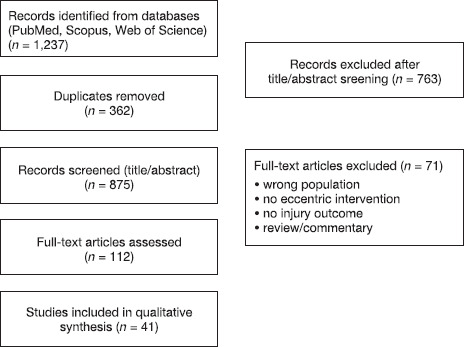
All search results were imported into a reference manager, and duplicates were removed. Two reviewers independently screened titles and abstracts for relevance. Full-text articles were obtained for studies deemed potentially eligible. The same reviewers assessed full texts against the inclusion criteria. Disagreements were resolved through discussion or by consulting a third reviewer. Reasons for excluding fulltext articles were documented. The PRISMA flow diagram summarises the number of records identified, screened, excluded and included (Figure 1).
Data extraction
Two reviewers independently extracted data from included studies using a standardised form. Extracted items included: study design, year of publication, sport and level (recreational vs professional), sample size and demographics, intervention characteristics (exercise type, volume, duration and supervision), comparator, adherence/compliance, definition of ham-string injury, followup duration, and reported outcomes (injury incidence per 1000 hours, strength measures, fascicle length and performance metrics) (Table 1). The study authors were contacted to clarify missing information when necessary.
Table 1
Characteristics of included studies
| Study | Sport/population | Sample size | Intervention | Injury definition | Outcome |
|---|---|---|---|---|---|
| Petersen et al. (2011) [6] | male professional and amateur soccer teams (50 Danish teams) | n = 942 | 10-week progressive Nordic hamstring programme plus weekly maintenance | overall, new and recurrent acute hamstring injuries per player-season | The intervention group showed significantly fewer injuries |
| Andrews et al. (2025) [2] | elite sprinters | n = 12 | 9-week eccentric training (Nordic hamstring) program | hamstring injury incidence (unspecified) | Eccentric training induced multiscale muscular adaptations (RCT) |
| van der Horst et al. (2015) [4] | amateur male soccer players (40 teams) | n = 579 | 25 sessions of the Nordic hamstring exercise over 13 weeks, in addition to regular soccer training | time-loss hamstring injury incidence during the season | NHE reduced hamstring injury incidence (odds ratio 0.282) with no significant change in injury severity |
| Podczarska- Głowacka et al. (2025) [11] | recreationally active adults (students) | n = 32 | 4-week Nordic hamstring exercise (3 sessions per week) | balance and knee- flexor strength (not injury incidence) | NHE improved postural balance and strength vs control |
| Timmins et al. (2016) [12] | elite football (soccer) players | 152 players | prospective cohort; baseline eccentric strength and fascicle length; no intervention | time-loss hamstring injury during season | Short fascicle length and weak eccentric strength were associated with higher injury risk |
| Vicens-Bordas et al. (2020) [14] | male amateur soccer players | n = 115 | cross-sectional study; measured eccentric strength; no intervention | hamstring injury history and eccentric strength | Lower eccentric hamstring strength was associated with age and prior injury history |
| Opar et al. (2015) [18] | australian footballers | n = 28 | prospective cohort; measured eccentric strength | hamstring injury incidence during season | Lower eccentric strength predicted higher hamstring injury risk |
| van de Hoef et al. (2019) [19] | professional soccer players | n = 43 players | NHE vs usual training | isokinetic strength and hamstring injury rate | NHE improved eccentric strength; no significant difference in injury rate due to low injury occurrence |
| Soligard et al. (2008) [20] | young female soccer players | n = 1055 | FIFA 11+ warm-up program | overall injury incidence | Warm-up programme reduced overall injuries, but the effect on hamstring injuries was not significant |
| Freeman et al. (2019) [21] | adolescent athletes | n = 20–30 participants | sprint training plus NHE vs sprint only | eccentric strength and sprint performance | Combined training resulted in greater improvement of eccentric strength and sprint performance than sprint-only |
| Liang et al. (2024) [22] | young dance students | n = 24 | eccentric training vs control | hamstring flexibility and strength | Eccentric training improved flexibility and strength compared with controls |
Risk of bias assessment
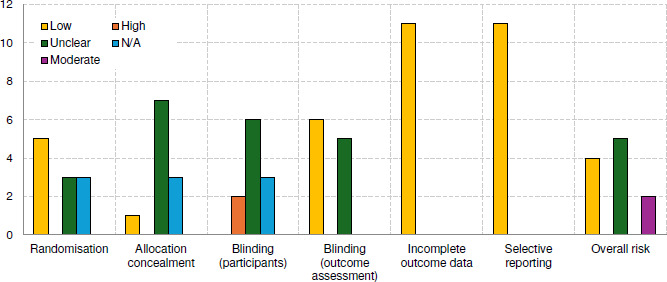
The methodological quality of each study was assessed independently by two reviewers. Randomised trials were appraised using the Cochrane risk of bias 2.0 tool, and nonrandomised studies were evaluated with the ROBINSI tool. We examined sequence generation, allocation concealment, blinding of outcome assessors, incomplete outcome data, selective reporting and other potential biases. Discrepancies were resolved by consensus. A summary table and figure present the risk of bias ratings across studies (Table 2 and Figure 2).
Table 2
Risk of bias assessment of included studies
| Study | Randomisation | Allocation concealment | Blinding (participants) | Blinding (outcome assessment) | Incomplete outcome data | Selective reporting | Overall risk |
|---|---|---|---|---|---|---|---|
| Petersen et al. (2011) [6] | low | low | unclear | low | low | low | low |
| Andrews et al. (2025) [2] | low | unclear | unclear | unclear | low | low | unclear |
| van der Horst et al. (2015) [4] | low | unclear | unclear | low | low | low | unclear |
| Podczarska-Głowacka et al. (2025) [11] | unclear | unclear | unclear | unclear | low | low | unclear |
| Timmins et al. (2016) [12] | N/A | N/A | N/A | low | low | low | low |
| Vicens Bordas et al. (2020) [14] | N/A | N/A | N/A | low | low | low | low |
| Opar et al. (2015) [18] | N/A | N/A | N/A | low | low | low | low |
| van de Hoef et al. (2019) [19] | low | unclear | high | unclear | low | low | moderate |
| Soligard et al. (2008) [20] | low | unclear | unclear | low | low | low | unclear |
| Freeman et al. (2019) [21] | unclear | unclear | high | unclear | low | low | moderate |
| Liang et al. (2024) [22] | unclear | unclear | unclear | unclear | low | low | unclear |
Data synthesis
Due to variability in sports, participant characteristics, injury definitions and training protocols, metaanalysis was not feasible. Instead, a narrative synthesis was undertaken. Injury incidence and secondary outcomes were summarised descriptively. Studies were grouped by sport (e.g., soccer, rugby, athletics), competition level (professional vs recreational) and injury definition (time loss vs clinical diagnosis). Subgroup trends, such as differences in effect size across sports or adherence levels, were noted. When sufficient data were available, we calculated relative risk reductions (e.g., percentage change in injury incidence) using reported exposure hours.
Certainty of evidence
The overall certainty of evidence for primary and secondary outcomes was evaluated using the GRADE approach, taking into account risk of bias, inconsistency, indirectness, imprecision and publication bias. Certainty ratings (high, moderate, low or very low) guided the interpretation of the findings and formulation of conclusions.
Results
Study selection
The search retrieved 1,237 records from PubMed, Scopus, and Web of Science. The study selection process is presented in the PRISMA flow diagram (Figure 1). After removing 362 duplicates, 875 titles and abstracts were screened. A total of 112 full-text articles were evaluated, and 41 studies met the inclusion criteria.
Study characteristics
The included studies involved male and female athletes at recreational to elite levels across football/soccer, rugby, basketball, futsal, handball, athletics, cricket, alpine skiing, and multisport settings. Sample sizes ranged from 18 to 765 athletes, and intervention durations varied from four to 52 weeks. Most trials implemented the Nordic hamstring exercise (NHE) as a standalone programme or as the eccentric component of a comprehensive injuryprevention protocol. Other interventions combined NHE with the FIFA 11+ program, plyo-metric or sprint drills, and neuromuscular training.
A summary of methodological characteristics is presented in Table 1.
Risk of bias assessment
Methodological quality was assessed using established tools: randomised trials were evaluated with RoB 2.0, and nonrandomised studies with ROBINSI. Randomisation and allocation concealment were generally adequate, but blinding of outcome assessors was rarely reported. Prospective cohort studies frequently exhibited selection and reporting biases.
The risk of bias assessment is presented in Table 2 and Figure 2.
Primary outcomes – injury incidence
Across studies reporting exposure-adjusted injury rates, individual trials have reported relative reductions in hamstring strain incidence ranging from approximately 45% to 60% compared with control or usual training conditions. Programmes combining the Nordic hamstring exercise with additional strengthening or lumbo-pelvic control exercises were associated with larger reported reductions, particularly when implemented at least twice weekly for more than eight weeks. Owing to heterogeneity in injury definitions (time loss vs clinical diagnosis), sporting contexts, and competition levels, these findings are summarised narratively rather than meta-analytically.
Secondary outcomes – strength, muscle architecture, and performance
Eccentric interventions were reported to be associated with improvements in hamstring function across included studies. Increases in eccentric knee-flexor strength were reported to range from approximately 10% to 25%, while biceps femoris fascicle length was reported to increase by approximately 5% to 15% [23]. These adaptations were most frequently observed in programmes lasting eight or more weeks and performed at least twice weekly. Studies reporting greater strength gains typically observed larger reductions in injury risk. When the Nordic hamstring exercise was integrated with sprint drills, sprint performance was reported to improve by approximately 1–3%. Combined eccentric and plyometric protocols were associated with increases in countermovement jump height of approximately 2–5%, and changeofdirection test times were reported to improve by 2–4%. These findings are summarised in the text.
Compliance and adverse events
Mean adherence ranged from 63% to 92%. Higher compliance correlated with greater injury reductions; programmes with adherence above 80% typically halve injury rates [24]. Reported adverse events were minimal and limited to transient delayedonset muscle soreness during the first one or two weeks. Across the included studies, no training-related injuries or participant withdrawals due to pain were reported.
Discussion
Principal findings
Analysis of the 41 included studies indicates that eccentric hamstring training, particularly the Nordic hamstring exercise, is consistently associated with meaningful reductions in hamstring strain incidence across multiple sporting contexts. These preventive effects appear most pronounced when eccentric loading is incorporated within multifactorial injury- prevention programmes and supported by adequate training frequency and adherence [4, 6, 7, 9–11, 16, 18–22, 25–30].
Evidence from prior systematic reviews and meta-analyses further supports these findings, reporting substantial preventive effects across different athlete populations [2, 3, 5, 17]. However, the magnitude of effect varies according to study design, intervention structure, and implementation quality. Owing to considerable methodological heterogeneity, direct quantitative pooling was not performed in the present review.
Mechanistic interpretation
Eccentric training addresses the late-swing phase of running, a period of increased vulnerability, by enhancing force production at extended muscle lengths, promoting fascicle lengthening through serial sarcomerogenesis, and improving neuromuscular control. Reviews also identify adaptations in non-contractile tissues, such as extracellular-matrix remodelling and potential changes in titin-based stiffness, which may collectively expand the force–length operating range and decrease peak strain during high-speed running [2–4]. Interventions that combine NHE with sprint or hip-extension drills may further enhance transfer by targeting both knee-dominant and hip-dominant phases of the sprint cycle, thereby improving acceleration, maximal speed mechanics, and load distribution within the hamstrings [17, 31–33].
Dose, progression, and maintenance
Current evidence supports a two-phase approach: an initial high-volume pre-season phase with gradual progression in range of motion and volume, followed by a pragmatic in- season maintenance phase consisting of approximately one to two sessions per week and 40–60 repetitions per week. This structure balances the magnitude of training effects with the management of muscle soreness and scheduling constraints [9, 11, 17, 19, 21, 27, 28, 32]. High-volume protocols offer slightly greater gains in strength and fascicle length, but both high- and low-volume approaches are effective with consistent adherence [17–22, 25–32, 34]. Continued maintenance appears important, as discontinuation has been associated with loss of training adaptations and potentially increased injury risk.
Role of adherence and implementation science
Adherence emerged as a key factor associated with programme effectiveness. When participants followed at least 80% of the sessions, injury rates dropped more significantly than in groups with lower compliance [2, 8, 9, 18, 19, 21, 22, 25, 27, 28, 35]. Participants often struggled with muscle soreness, limited support, and scheduling challenges. Some common reasons people struggled to adhere to the programme were concerns about muscle soreness, a lack of support from others involved, and scheduling difficulties. On the other hand, gradually increasing the difficulty, providing technical coaching, including NHE in warm-ups, and starting with assisted versions helped people manage soreness and improve their technique. These results underscore the critical importance of implementation methods in determining programme success.
Performance and transfer effects
Structured eccentric training programmes may contribute to both injury prevention and improvements in selected performance outcomes. Most studies found neutral or positive effects on sprint performance, with improvements of approximately 1–3% over distances of 5–30 m, as well as modest gains in vertical jump and change-of-direction assessments. These benefits were particularly evident when eccentric training was combined with sprint or plyometric exercises [7, 9, 14, 19, 21, 27, 29, 30, 32, 36, 37].
Research suggests that pre-season assessment of eccentric strength may help identify athletes at elevated risk of subsequent hamstring injury. Age and past injuries are more reliable indicators [38, 39]. While eccentric training is beneficial for preventing injuries, relying solely on pre-season strength tests is insufficient. A thorough assessment should also consider exposure, injury history, strength, muscle structure, and sprinting technique.
Safety and adverse events
Adverse events were minimal across varied participant groups. Delayed-onset muscle soreness (DOMS) frequently occurred during the initial one to two weeks but was effectively managed through gradual progression, coaching, and, when appropriate, the use of assisted Nordic exercises [11, 13, 18, 19, 21, 27, 28, 32]. No studies reported serious injuries or consistent reductions in player availability attributable to the intervention.
Heterogeneity, risk of bias, and certainty (GRADE)
Interpretation of the present findings should consider the methodological limitations identified in the risk of bias assessment. Several included trials demonstrated unclear or high risk in domains related to allocation concealment and blinding, which is inherently challenging in exercise-based interventions. In addition, variability in adherence monitoring and exposure reporting may have influenced observed effect estimates. These factors suggest that the preventive effects of eccentric hamstring training, while consistent, should be interpreted with moderate caution. Observed heterogeneity among studies is likely attributable to variations in participant demographics (sport, sex, age), exposure measurement (match- vs training-weighted), injury definitions (time loss vs clinical diagnosis), programme structure (isolated NHE vs integrated approaches), progression of volume and range of motion, and, importantly, adherence reporting [4, 7, 13–15, 17, 32, 36, 37, 40]. Overall, the quality of included trials ranged from moderate to high, with common methodological risks related to allocation concealment, assessor blinding, and adherence documentation. The consistent direction of reported effect estimates supports moderate certainty for primary prevention outcomes. Certainty is low to moderate for muscle architecture and performance adaptations due to protocol and measurement variability [6, 8, 9, 19, 29, 30, 32, 37].
Publication bias and small-study effects
Evidence for publication bias was limited or inconclusive. However, the possibility of small-study effects remains, given the predominance of soccer cohorts and insufficient reporting of exposure-adjusted injury rates in smaller trials. Because of these factors, it is important to interpret effect sizes carefully. Researchers should also preregister their studies, ensure they have a sufficient number of participants, and clearly report the extent to which participants adhered to the study and interventions they were exposed to [4, 13, 14, 36, 37, 40].
Practical implications
Adopt a two-phase structure: pre-season build-up (technique + volume progression) in-season maintenance (1–2 sessions•week–1).
Integrate, do not isolate: combine NHE with hip-dominant extension work, lumbopelvic control, and sprint-mechanics drills for maximal transfer [7, 20, 26, 31, 32].
Coach the details: emphasise long-length control, torso–pelvis alignment, and gradual range of motion (ROM); consider assisted Nordics early to manage DOMS [21, 28].
Operationalise adherence: embed sessions into warm-ups, monitor completion, and educate athletes on performance upside [9, 18, 25, 26].
Contextualise by sport and sex/age: evidence is strongest in men’s soccer; purposeful implementation in women’s and court/ice sports is warranted [9, 14, 20, 26, 35].
Future research
Dose–response trials contrasting explicit volume/ROM progressions and in-season maintenance schedules [17–22, 25–32, 34].
Modality comparisons (NHE vs flywheel vs long-length Romanian deadlift (RDL) variants) with matched workloads and shared endpoints (architecture, strength, exposure-adjusted injury) [7, 32, 37].
Mechanistic studies linking in-vivo architecture changes, neuromuscular control, and tissue-scale mechanics during sprinting [2–4, 31].
Under-studied populations: women, youth in court/ice sports, and elite sprint groups [14, 20, 35].
Implementation science: pragmatic trials testing adherence strategies under match scheduling congestion and travel [18, 25].
Overall interpretation
In summary, the effectiveness of risk reduction is determined primarily by the quality of implementation and sustained adherence, rather than the specific exercise modality. Long-length eccentric training should be regarded as a foundational strategy for injury prevention in running and field sports [4, 6–11, 16, 18–22, 25–30].
Limitations
This review has several limitations that should be considered when interpreting its findings. First, the included studies were heterogeneous with respect to participant characteristics (age, sex, competitive level, and sport), intervention content (isolated NHE vs multi-component programmes), training volume and progression, and follow-up duration. Such variability limited the ability to directly compare protocols and may partly explain the range of effect sizes observed for both injury reduction and performance outcomes. In several studies, injury definitions and exposure reporting also differed (e.g., time loss vs clinically diagnosed injuries; training-only vs match-plus-training exposure), which may have introduced measurement bias into the pooled incidence estimates.
Secondly, although 41 studies were included, robust evidence was concentrated in male soccer cohorts, with comparatively few trials in women, youth, and athletes from court, ice, and track sports. This sport- and sex-specific imbalance limits the generalisability of the conclusions beyond men’s football and rugby [41]. In addition, many trials enrolled relatively small samples and were underpowered for injury outcomes, increasing the possibility of type II error and small-study effects. Adherence and implementation strategies were inconsistently reported, which limits the precision of dose– response inferences regarding training volume, frequency, and maintenance.
Further, risk of bias was present in several domains across the primary literature, particularly allocation concealment, blinding of outcome assessors, and completeness of adherence and exposure data. These methodological issues may have inflated effect sizes in some studies. Finally, the review relied on published peer-reviewed articles indexed in major databases, and not all studies provided sufficient data to enable full quantitative synthesis for every outcome. As a result, some conclusions are based on narrative synthesis rather than meta-analysis and should be interpreted with appropriate caution.
Conclusions
This systematic review indicates that eccentric hamstring training, particularly programmes incorporating the Nordic hamstring exercise, is associated with reductions in hamstring injury incidence. Improvements in eccentric strength and muscle architecture may partly explain these protective effects, while modest performance-related benefits have also been reported. Programme effectiveness appears to depend more on adequate training dose and adherence than on programme complexity. However, the certainty of the evidence remains moderate, primarily due to heterogeneity in study design, participant characteristics, and injury definitions. Future research should prioritise strategies to enhance long-term adherence, include underrepresented populations such as female athletes and athletes in non-soccer sports, and examine the sustainability of preventive effects over extended follow-up periods.