

Introduction
Neck pain is a major public health concern, ranking as the fourth leading cause of disability worldwide, with an annual prevalence of 27.0 per 1000 individuals [1]. While many acute cases resolve spontaneously, approximately 50% of patients experience persistent or recurrent symptoms, leading to significant healthcare costs and reduced productivity [1, 2].
Chronic nonspecific neck pain (CNNP) affects up to 67% of the global population and presents a complex clinical challenge [3]. It is characterised by neck pain without a clear pathological cause, influenced by physical, lifestyle, and psychosocial factors [2, 4]. Emerging evidence links CNNP to myofascial pain syndrome, marked by hypersensitive trigger points in cervical muscles [4]. Psychosocial factors such as catastrophising, stress, anxiety, and depression also significantly influence pain perception and treatment outcomes [1, 5].
CNNP is characterised by persistent pain, restricted mobility, or a dull, burning sensation in the cervical region and shoulder girdle, often accompanied by tenderness in muscles such as the trapezius, levator scapulae, or splenius cervicis [4, 6]. These symptoms are frequently associated with cervical or shoulder dysfunction, as well as increased physical and psychological stress [7]. Due to its multifactorial nature, CNNP typically requires a multidisciplinary therapeutic approach [8]. Conservative treatments include analgesic medications such as opioids, NSAIDs, COX-2 inhibitors, muscle relaxants, tricyclic antidepressants, and benzodiazepines, though their risks of dependency and adverse effects must be considered [9]. Physical therapy is a cornerstone of CNNP management, incorporating exercises, stretching, electro-therapy, and manual therapy [10–12].
Laser therapy is a widely used modality for musculoskeletal pain, including neck pain [13, 14]. It employs non-ionising light in the red and infrared spectra, characterised by monochromaticity, coherence, and directional radiation [15]. Laser energy is absorbed by tissue chromophores such as water, haemoglobin, melanin, and cytochrome c oxidase, enhancing mitochondrial function and increasing ATP production, thereby promoting tissue repair and analgesia [15, 16]. Physiological mechanisms contributing to pain relief include reduced nociceptive conduction, -endorphin release, and modulation of inflammatory mediators [13, 17, 18].
Laser devices are classified by emission power into low-level laser therapy (LLLT, class IIIb, < 0.5 W) and high-intensity laser therapy (HILT, class IV, > 0.5 W) [16, 18]. LLLT primarily induces superficial photobiomodulation effects, while HILT integrates photobiomodulation with photothermal effects, allowing deeper tissue penetration and enhanced energy delivery [18–20].
Strong evidence supports LLLT for CNNP, demonstrating reductions in pain and disability [13, 20]. HILT, an emerging alternative, combines photothermal and photobiomodulation effects, potentially offering greater therapeutic benefits [18, 21–23]. However, evidence for HILT in CNNP remains limited [19, 22], despite its demonstrated efficacy in other musculo-skeletal disorders. Further research is essential to establish its clinical utility.
This study aims to evaluate the effects of HILT on CNNP, assess the feasibility of a standardised treatment protocol, and identify potential adverse effects, serving as a foundation for future randomised clinical trials (RCTs). By providing clinical insights, this research will contribute to the evidence base for HILT in CNNP management and inform subsequent clinical applications.
Subjects and methods
Study and design
The study is a non-controlled clinical trial with an experimental design. This study adheres to the CONSORT 2010 Statement (Extension for Randomised Pilot and Feasibility Trials) [24].
Sample size
The sample size was calculated using the G*Power software, considering a power of 90%, a 95% confidence level, and a 5% significance level ( ), based on an effect size of 0.6 [25]. This estimation was derived from previous studies comparing HILT plus exercise to ultrasound plus exercise in patients with neck pain, which reported a greater reduction in pain intensity favouring HILT (effect size = 0.53) [18, 26, 27]. The minimum required sample size was 17; however, a 15% increase was applied to ensure compliance with the PEDro scale criterion related to sample size adequacy and to account for potential dropouts, resulting in a final sample size of at least 20 participants [18, 28, 29].
Participants and eligibility criteria
Participants were recruited from Andrés Bello University (Santiago, Chile). The study was promoted through various channels, including university mailing lists, the official website, email, social media, and notice boards of the Department of Physical Therapy. Individuals reporting neck pain were contacted directly by phone or email and invited to participate. All evaluations were conducted at the Electrophysical Agents Laboratory, ensuring an accessible and structured recruitment process.
Eligibility criteria were defined in accordance with established definitions reported in prior studies [30–32]. Participants aged 18 years or older, of any sex, with pain lasting at least three months were eligible for inclusion. A minimum score of 5 on the Neck Disability Index (NDI) and a resting pain score of 3 or higher on the Numeric Pain Rating Scale (NPRS) were also required [18, 30–32].
Exclusion criteria included [18]: (a) musculoskeletal injuries of the neck or shoulders within the last three months; (b) osteosynthesis near the shoulders, neck, or surrounding areas; (c) wounds or skin conditions in the neck or shoulder region, such as psoriasis, scars, or burns; (d) regular use of analgesics, anti-inflammatory drugs, or muscle relaxants; (e) neurological conditions, such as paresthaesia, sensory loss, weakness, or colour changes in the neck, arms, forearms, or hands; (f) a diagnosis of photosensitivity; (g) Fitzpatrick skin types V and VI; (h) solar urticaria or adverse reactions to sunlight; (i) autoimmune diseases, including dermatomyositis, systemic lupus erythematosus, hepatic porphyria, carcinoid cutaneous syndrome, or pellagra; (j) cancer or tumours diagnosed in the past five years; and (k) epilepsy. Table 1 summarises the inclusion and exclusion criteria applied in this study.
Table 1
Eligibility criteria
Interventions
Participants received HILT combined with a bilateral neck muscle stretching program [12, 33]. An independent therapist administered the interventions twice per week for four weeks, totalling eight sessions, each concluding with stretching.
HILT protocol
The treatment followed the protocol proposed by de la Barra et al. [18], integrating both scanning and point techniques. It consisted of three phases:
Manual scanning: 12 W of power was applied for 42 s, delivering 500 J over a 100 cm2 area on each upper trapezius muscle, totalling 1,000 J per session [18, 34].
Point technique: A 25% duty cycle was used to apply 4 W of mean power for 10 s per point, delivering 10 J per point and 60 J per side, targeting the most sensitive points identified through algometry [18, 34].
Manual scanning: 6 W of power was applied for 83 s, delivering 500 J over a 100 cm2 area on each upper trapezius muscle, totalling 1,000 J per session. Laser therapy was administered using a BTL-6000® device with a 1,064 nm wavelength.
Stretching protocol
Participants performed a bilateral passive static stretching protocol targeting the upper trapezius, levator scapulae, and scalene muscles, given the established benefits of these exercises for cervical pain [12, 33]. Each session included three sets of 30-second stretches, with a 30-second rest interval between sets. Stretching exercises were performed in a seated position.
Assessment procedures
The study evaluated five outcomes: resting pain intensity (RPI), movement pain intensity (MPI), cervical range of motion (CROM), pressure pain threshold (PPT), and neck disability (ND). RPI, MPI, PPT, and ND were considered primary outcomes, while CROM was assessed as a secondary outcome. Assessments were conducted at baseline, post-treatment, and at one-month follow-up. Two independent assessors measured RPI, MPI, and CROM, while PPT was assessed by a separate evaluator. ND was self-reported by participants. The following instruments were used: NPRS, pressure algometry, cervical inclinometry, and the NDI.
RPI and MPI
The numeric pain rating scale (NPRS) evaluates perceived pain intensity on an 11-point scale, ranging from 0 (no pain) to 10 (worst possible pain) (test-retest reliability r = 0.79–0.96) [35]. Participants reported pain intensity at rest and during cervical movement in all planes (flexion, extension, rotation, and lateral flexion).
PPT
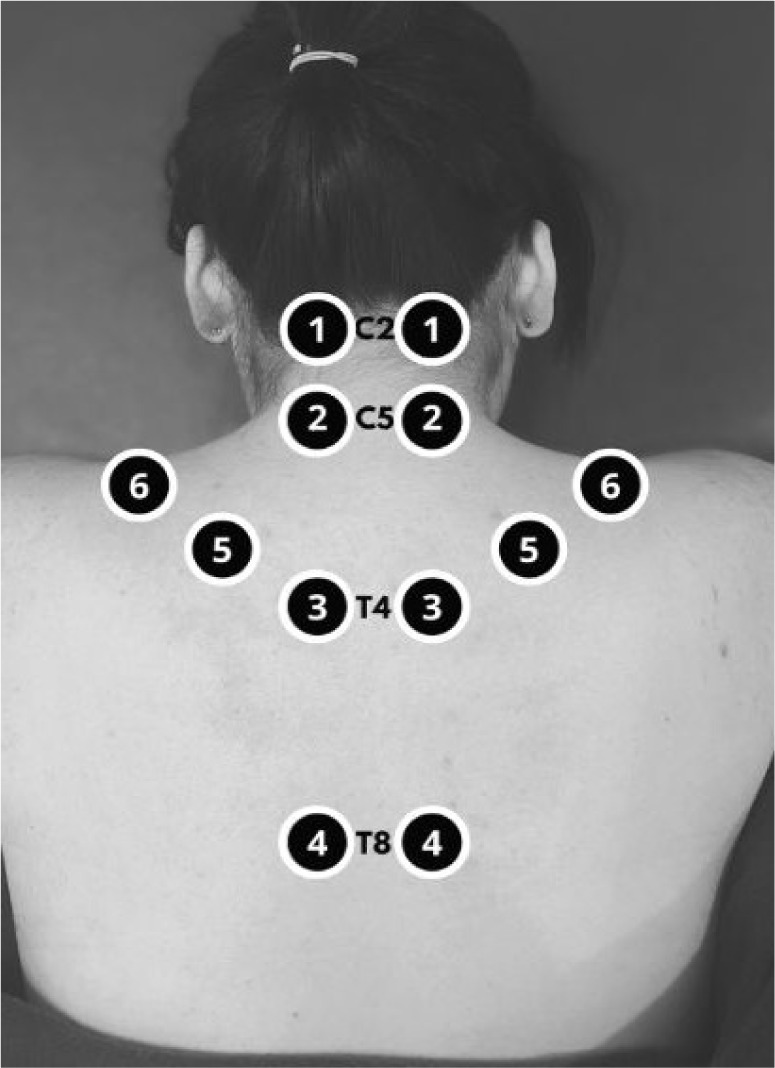
PPT was assessed using a Wagner FPX® digital algometer. Six bilateral points were evaluated (Figure 1): 2 cm lateral to the spinous processes of the C2, C5, T4, and T8; the midpoint of the upper trapezius muscle (between the C7 and acromion); the levator scapulae muscle (2 cm superior to the superior angle of the scapula); and the mid-third of the trapezius muscle [18, 34]. Measurements were taken three times at each point within a 30-second interval. The mean PPT value was recorded across the twelve points and expressed in pounds (lb). Intra-evaluator reliability (intraclass correlation coefficient, ICC) was determined prior to the study by assessing the PPT at the upper trapezius muscle (midpoint between the spinous process of C7 and the posterior border of the acromion) in thirteen healthy volunteers, with a 48-hour interval between evaluations [36].
CROM
A CROM® inclinometer was used to measure active neck movements [37], including flexion, extension, right and left lateral flexion, and right and left rotation. Three attempts were made for each cervical movement, with a 30-second interval between each, and the best of the three values was recorded.
ND
Disability was assessed using the validated Spanish version of the NDI [38]. The NDI is composed of 10 sections with questions about neck pain symptoms and daily activities. Each section is scored from 0 to 5, with higher scores indicating greater disability [39, 40]. The NDI was self-administered, and the percentage of cervical disability for each participant was recorded.
Statistical analysis
Descriptive statistics (means, standard deviations, medians, and interquartile ranges) were used to summarise the RPI, MPI, PPT, CROM, and ND variables according to the data distribution [40]. Normality was assessed using the Shapiro– Wilk test, and homogeneity of variances was evaluated with Levene’s test. Due to the presence of a non-normal distribution and heteroscedasticity in several outcome variables at T1 and/or T2, the Friedman test was applied to assess differences across repeated measures. The Wilcoxon signed-rank test was used for pairwise comparisons between evaluation time points. Effect sizes (Cohen’s d) were calculated for outcomes with statistically significant differences. A significance level of 0.05 was adopted for all analyses. Data analysis was performed using the IBM SPSS Statistics (version 26) and Graph-Pad Prism software.
Results
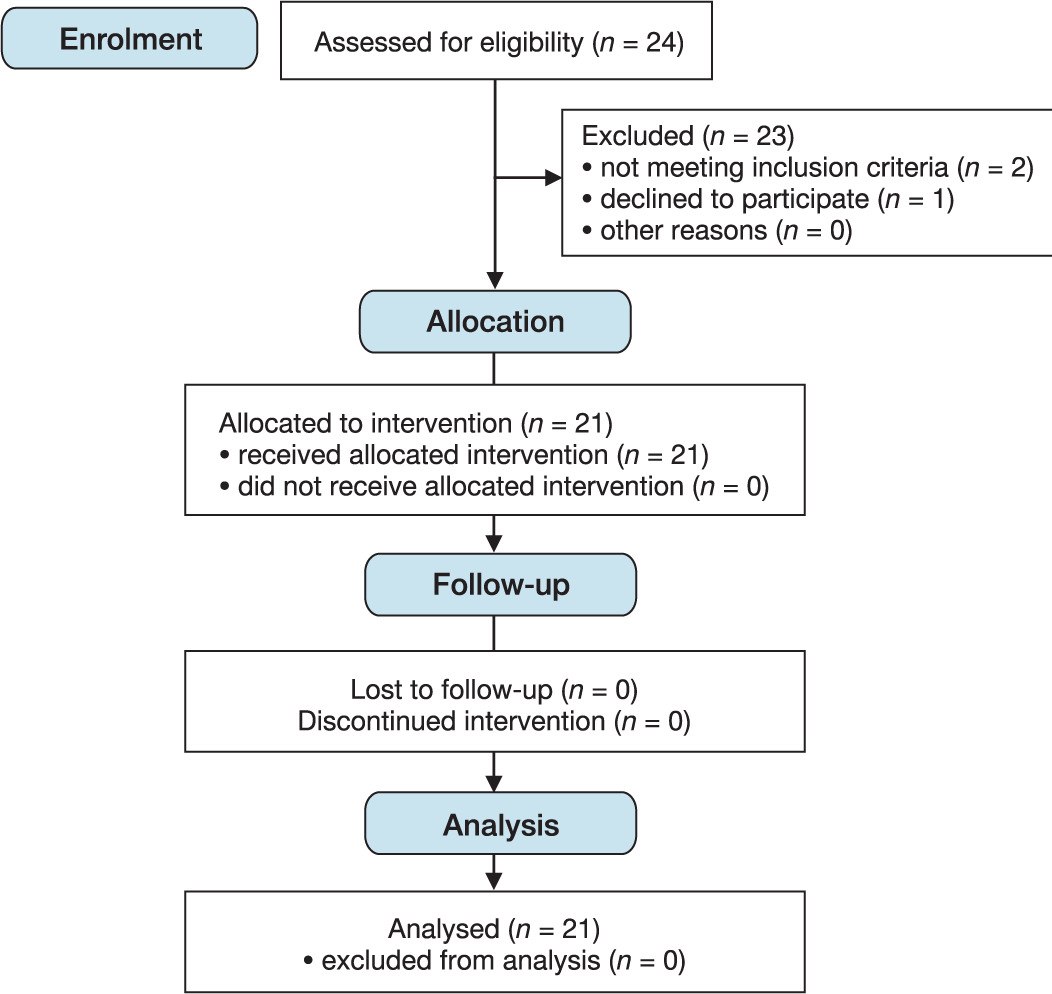
A total of 24 volunteers diagnosed with CNNP were initially recruited for this study. However, two participants were excluded due to a history of malignancy and psoriasis, and one participant declined to participate. Consequently, the final sample consisted of 21 participants (14 women, 7 men). The mean age of the participants was 33.5 years (SD = 14.1), and the mean body mass index (BMI) was 26.5 kg/m2 (SD = 4.3). Participants underwent eight sessions of HILT combined with neck stretching exercises over a 4-week period [18]. All participants completed the treatment and evaluation sessions (T0: baseline, T1: post-treatment, T2: follow-up) without any dropouts. A flow diagram of the study is presented in Figure 2.
The reliability of the PPT measurements was demonstrated by an excellent ICC of 0.76 [34]. Table 2 presents the demographic characteristics of the participants along with baseline values for the study variables. At baseline (T0), the Shapiro–Wilk test indicated that all outcome measures were normally distributed, except for resting pain intensity (RPI, p = 0.01) and cervical right-side bending (p < 0.05). Among demographic variables, only age showed a non-normal distribution. These results are detailed in Table 2.
Table 2
Demographic characteristics of participants
Table 3 presents the results for the outcomes of interest assessed at the three evaluation time points (T0, T1, and T2). As the outcome variables showed non-normal distributions at post-treatment (T1), follow-up (T2), or both, non-parametric tests were applied: the Friedman test was used to assess differences across the assessment points, and the Wilcoxon signed-rank test was used for pairwise comparisons (T0–T1, T0–T2, and T1–T2).
Table 3
Comparison of results for relevant outcomes between treatment sessions
[i] CROM – cervical range of movement, IQR – interquartile range, NDI – neck disability index, NPRS – numeric pain rating scale PPT – pain pressure threshold
* statistically significant (p < 0.05)
** distribution determined with Shapiro–Wilk normality test
*** differences between sessions evaluated with Friedman’s statistic
+ comparisons between the variables evaluated using the Wilcoxon signed-rank test
++ effect size assessed using Cohen’s d statistic
Outcomes
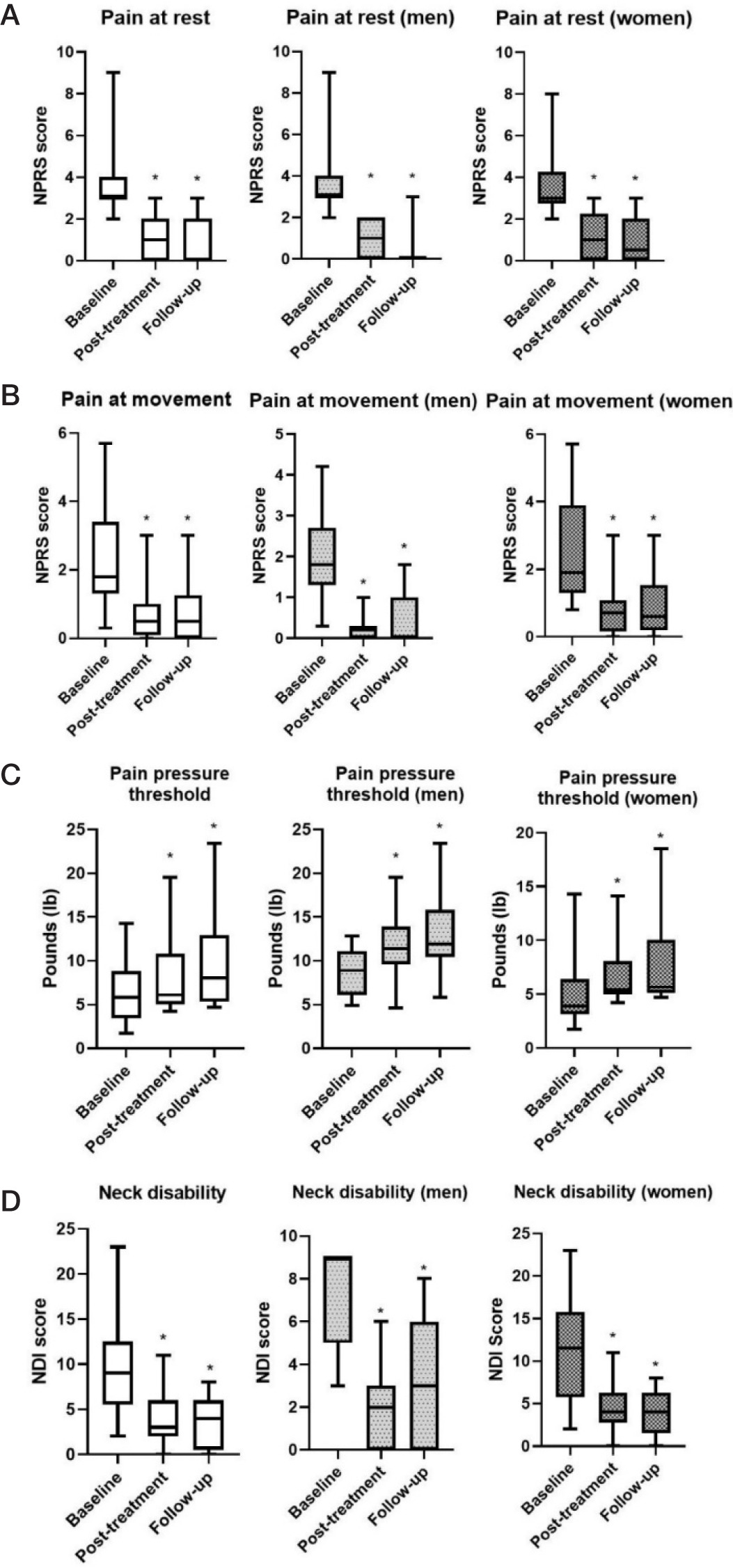
RPI. A statistically significant reduction in cervical pain intensity was observed over time (p < 0.05). Post hoc comparisons (Wilcoxon test) indicated that the reduction was particularly evident between T0 and T1 (mean difference: 2.6; 95% CI: 1.9 to 3.2) and between T0 and T2 (mean difference: 2.7; 95% CI: 1.9 to 3.2), both with large effect sizes (d = 1.7–1.8; p < 0.01). No statistically significant difference was observed between T1 and T2. Subgroup analysis by sex showed consistent findings, with significant reductions in pain intensity for both groups (p < 0.05) and slightly greater improvements observed in the men (mean reduction: 3.0) compared to the women (mean reduction: 2.4). Median differences in RPI across the three evaluation sessions are illustrated in Figure 3A.
MPI
Significant differences (p < 0.05) were observed across evaluation sessions and in pairwise comparisons (p < 0.01). MPI decreased from 2.3 (SD = 1.4) at T0 to 0.7 (SD = 0.8) at T1 and 0.8 (SD = 1.0) at T2, with large effect sizes (d = 1.2– 1.4, p < 0.05). Subgroup analysis revealed a greater reduction in the men, from 2.0 (SD = 1.2) at T0 to 0.3 (SD = 0.3) at T1 and 0.5 (SD = 0.7) at T2. Figure 3B displays the median differences in MPI across the sessions.
Mean PPT
A statistically significant increase in PPT (p < 0.05) was observed across the evaluation sessions. Pairwise comparisons revealed an increase of 1.9 lb (95% CI: 1.5, 2.4) between T0 and T1 and 3.2 lb (95% CI: 2.6, 3.5) between T0 and T2, both statistically significant (p < 0.01), with moderate effect sizes (d = 0.5–0.7). Subgroup analysis by sex showed that the men had a greater increase in PPT, with increases of 2.7 lb (T0-T1) and 3.1 lb (T0–T2), both significant (p < 0.05), with large effect sizes (d = 0.9–1.7). Figure 3C shows the changes in medians and interquartile ranges across sessions for the entire group and by sex.
ND
A significant reduction in the NDI score (p < 0.05) was observed across all evaluation sessions. Average reductions were from 10.0 (SD = 5.4) to 3.8 (SD = 3.0) for T0–T1 and to 3.7 (SD = 2.9) for T0–T2, both with large effect sizes (d = 1.4–1.5, p < 0.01). Subgroup analysis revealed that the women showed greater reductions in disability scores, with reductions of 6.5 (95% CI: 5.8–7.2) for T0–T1 and 7.3 (95% CI: 6.5–7.8) for T0–T2, both with large effect sizes (d = 0.8). Figure 3D illustrates the median differences and interquar-tile ranges for all participants, as well as differences by sex.
CROM
CROM increased for all movements, with significant differences (p < 0.05) observed only for cervical flexion and left side bending. Flexion improved from 52.3° (SD = 11.5) to 61.0° (SD = 8.4) for T0–T1 (p < 0.01), with no significant change at follow-up (59.0°, SD = 8.3). The effect size was large (d = 0.7–0.9). The men showed significant differences in neck flexion, with a 9.6° increase (95% CI: 9.2–9.8) and a large effect size (d = 0.8). Left inclination showed significant differences (p < 0.05) for T0–T1 and T1–T2, with a 6.2° increase that remained stable at follow-up, showing a moderate effect size (d = 0.5–0.6).
Discussion
This study was designed as a feasibility trial to evaluate the implementation, safety, and preliminary clinical effects of a standardised HILT protocol in patients with CNNP [41, 42]. Although HILT has shown promising results in various musculoskeletal conditions, its application in CNNP remains underexplored, with recent systematic reviews highlighting the scarcity of clinical trials in this population [14]. Conducting a feasibility study is an essential step prior to a full-scale RCT, as it makes it possible to assess protocol adherence, participant retention, and initial clinical outcomes, while also identifying potential logistical or methodological barriers.
Our findings suggest that HILT, when combined with stretching exercises, appears to be a safe intervention that may contribute to reductions in cervical pain and improvements in function in individuals with CNNP. Observed improvements in RPI, MPI, and PPT highlight the potential clinical relevance of this approach. No adverse events were reported, supporting the safety of the proposed protocol. Subgroup analysis indicated greater improvements among male participants, suggesting possible sex-related differences in treatment response. Nonetheless, these findings are preliminary, and future RCTs with appropriate comparator groups are required to validate these results and establish the effectiveness of HILT relative to other physical therapy interventions.
Fundamentals of applying HILT to neck pain
HILT alleviates cervical pain primarily through the anal-gesic effects of photobiomodulation. Cytochrome c oxidase (CCO), a key enzyme in the mitochondrial electron transport chain, absorbs laser radiation, stimulating ATP production, promoting tissue repair, and reducing pain [15, 43]. Photobiomodulation promotes the release of nitric oxide (NO) at the mitochondrial level, leading to vasodilation and modulating the production of reactive oxygen species (ROS), which contributes to reducing inflammation in chronic and neuropathic pain. Elevated ROS levels increase neuronal excitability and activate the Transient Receptor Potential Vanilloid (TRPV) ion channels, playing a key role in neuroinflammation and pain sensitisation [15, 43, 44].
HILT also enhances analgesia by stimulating endogenous opioid peptide synthesis, such as -endorphin, and reducing nociceptive mediators like bradykinin [14, 15, 18]. It lowers proinflammatory neuropeptides (substance P and CGRP), alleviating peripheral sensitisation and neurogenic inflammation [45]. HILT also increases serotonin (5-HT) in the CNS, activating descending pain modulation pathways and inhibiting nociceptive signals at the spinal dorsal horn [46]. Moreover, it downregulates inflammatory molecules (NF- B, pros-taglandin E2, TNF- , COX-2, and interleukin-1) that contribute to pain and inflammation [47]. Finally, HILT combines photo-biomodulation with thermotherapy, disrupting the spasm-pain cycle and promoting muscle relaxation. Heat enhances pain relief by reducing TRPV1 receptor activity at temperatures above 42°C [16, 18].
HILT and pain intensity
The results indicate an average reduction of 2.6 points (SD 1.1) in resting pain, corresponding to a 72% change on the NPRS. These findings align with the minimally detectable change (MDC) for the NPRS, ranging from 2.0 to 3.0 points, or alternatively suggest a reduction of at least 33% in chronic musculoskeletal pain, with values below 1.5 considered clinically irrelevant [48]. Stratification by sex revealed a reduction of 3.0 points in the men and 2.4 points in the women. This trend persisted at follow-up, with the women showing a reduction of 2.3 points after one month, while the men exhibited a more significant decrease, with a mean reduction of up to 3.5 points.
Hormonal, physiological, and neurobiological factors may explain the observed differences in analgesic response between the men and women. Testosterone, which is more prevalent in men, may enhance the modulation of descending pain pathways by influencing opioid receptors, thereby increasing analgesic efficacy [49]. Men’s greater muscle mass and lower adipose tissue may also facilitate the absorption of laser radiation in HILT therapy, enhancing its interaction with chromophores such as haemoglobin and myoglobin and optimising the distribution and therapeutic effects [39, 50]. Differences in the activation of pain-related neurobiological pathways and in the levels of inflammatory mediators and neuropeptides – such as -endorphin and substance P – may also contribute to a more pronounced analgesic response in men [13, 15, 46]. Psychological and social factors, including the tendency of men to report lower pain perception, could further influence the outcomes observed [51].
Importantly, emerging evidence has confirmed functional sexual dimorphism in human nociceptors: prolactin selectively sensitises female sensory neurons, while orexin B increases excitability in male neurons, indicating distinct peripheral mechanisms of pain modulation between sexes [52, 53]. Although our study was not originally designed to assess sex-specific effects and included an unbalanced sample, the exploratory findings suggest that biological sex may influence treatment response. These insights highlight the need for future trials to incorporate sex-stratified analyses and ensure balanced group allocation, thereby enhancing the rigour and clinical relevance of research in pain management.
Other variables, such as total energy delivered and the number of treatment sessions, may also influence HILT’s analgesic effects. According to the Arndt-Schulz law, varying energy doses could produce more pronounced effects [43]. These factors suggest that women might require higher doses or additional sessions to achieve similar outcomes to men.
HILT and PPT
Pressure algometry, used to determine the PPT, is a reliable method for assessing cervical sensitivity. Alongside the NPRS, it offers complementary insights into the pain experience [54]. The excellent test-retest reliability of the PPT assessments, as evidenced by the ICC, further supports their consistency in this study. The upper trapezius muscle, a commonly assessed site, makes this test especially useful for tracking changes over time [54, 55]. The protocols were strictly adhered to, including three bilateral evaluations per point with one-minute intervals between measurements [53].
The results demonstrated a mean increase in PPT of 2.1 lb at the end of treatment, which rose to 3.2 lb at the one-month follow-up without additional intervention. These improvements exceeded the MDC for algometry (0.40–0.54 lb, 0.45–0.62 kg/cm2) in CNNP [55, 56]. The men exhibited consistent increases of 2.3 lb post-treatment and 4.1 lb at follow-up, while the women exceeded the MDC only at follow-up (2.8 lb), with a smaller post-treatment increase of 1.4 lb. Sex significantly affects PPT, with women generally exhibiting lower thresholds than men. This may be attributed to hormonal differences, increased nervous system sensitisation, and distinct pain perception patterns [56, 57]. The duration of the pain also influences the PPT values, with acute pain associated with lower thresholds than chronic pain, possibly reflecting peripheral sensitisation during the early stages and adaptive mechanisms in chronic phases. Traumatic pain is also linked to lower thresholds compared to non-traumatic pain, suggesting central sensitisation related to traumatic events. While psychological factors such as pain catastrophising and fear of movement accounted for a small portion (5.9%) of PPT variability, biological and contextual variables had a more substantial impact on these outcomes [55].
HILT and disability
Patient-Reported Outcome Measures (PROMs) are crucial for assessing treatment efficacy, as they provide a comprehensive perspective on patients’ subjective experiences and the impact of chronic pain on daily life and functionality [57]. Unlike traditional clinical measures, PROMs capture patients’ self-assessments of their health and well-being, making it essential to evaluate both pain intensity and disability to fully understand the challenges in daily activities, social interactions, and psychological well-being, given their close relationship [57, 58].
RCTs commonly use the NDI scale to measure the magnitude and significance of disability. In this study, a reduction in disability was observed, with an average change of 6.2 points on the NDI at the end of treatment. This change was slightly below the MDC range of 8.8 to 10.4 points but exceeded the minimal clinically important difference (MCID), estimated at between 3.5 and 5 points, with a clinically important change calculated as 5 points (sensitivity 0.78 and specificity 0.80) [59, 60]. The observed changes were consistent for both men and women, with improvements of 5.4 points in men and 6.5 points in women.
Although treatments like HILT primarily focus on pain management, their impact on disability does not always follow a direct relationship [14, 61]. Pain is a multidimensional phenomenon involving psycho-affective factors, which significantly contribute to the variability of treatment outcomes and the extent of disability reduction. The use of validated questionnaires, such as the NDI, is valuable and highlights the importance of incorporating such evaluations in future studies to better assess treatment effects [38, 39].
HILT and CROM
The findings reveal statistically significant differences in cervical flexion and lateral bending, with improvements of 8.7° and 5.8°, respectively, aligning with the MCID values (6° and 5°, respectively) [16, 59]. Sex-stratified analyses maintained these changes, which persisted throughout the follow-up assessments, indicating stability in the results. HILT demonstrated clinically significant improvements in cervical extension (4.9°, MCID 4°) and left rotation (5.6°, MCID 5°) [14, 57], despite not showing statistically significant results in other planes. These effects were sustained in the post-treatment assessment.
The combination of heat and muscle stretching – both known for their ability to improve ROM – may partially explain the benefits observed with HILT, particularly when combined with muscle stretching. Heat-induced muscle relaxation (phase 2 of the protocol) and the reduction of the muscle spasm-pain cycle likely contribute to the improvement in CROM. However, to optimise CROM across all planes, it is advisable to consider a sweeping application covering the entire posterior neck region, rather than limiting treatment to the upper trapezius alone. While improving CROM is not a primary objective of HILT, these results highlight its potential contribution to enhancing cervical functionality.
Feasibility
The study demonstrates feasibility based on several factors [41, 42]: (i) HILT effectively reduced pain and cervical disability, as evidenced by the improvements in RPI, MPI, and NDI scores, which should be confirmed in future studies; (ii) The HILT dose used yielded positive results with easy application and straightforward systematisation, suggesting that adding a scan of the posterior neck muscles could further enhance the effects; (iii) The treatment session, lasting 15 to 20 minutes when combined with exercises, is easily replicable; (iv) The protocol showed strong participant retention, with no dropouts; (v) Adhering to photobiomodulation application guidelines, including the use of protective eyewear and excluding red flags such as malignancy or photosensitivity, ensures safety, with no adverse effects reported either in the short term or during follow-up.
Limitations
This study was conducted as a feasibility trial, which inherently focuses on assessing protocol implementation, safety, adherence, and preliminary clinical responses, rather than establishing definitive treatment effectiveness [41, 42]. Although the findings suggest potential benefits of HILT combined with stretching exercises for CNNP, they remain exploratory and should be confirmed in larger, controlled trials. The absence of a control group restricts the ability to compare the outcomes with other interventions.
Additionally, although the sample size was calculated a priori based on expected effect sizes, the number of participants may limit the generalisability of the results. Furthermore, the one-month follow-up period may be insufficient to capture long-term treatment effects, suggesting that researchers require extended follow-up in future studies. An important limitation is the unbalanced sex distribution in the sample, which may have influenced the treatment response and limits the generalisability of the findings. While the primary aim of this study was to assess feasibility rather than to evaluate sex-related differences, this limitation should be acknowledged. Given emerging evidence on sex-related pain mechanisms, future RCTs should ensure balanced representation across sexes and incorporate sex-stratified analyses to confirm these preliminary observations and better understand differential treatment responses. A full-scale RCT would be a logical next step to determine the comparative effectiveness of HILT against other physiotherapeutic approaches.
Implications for practice and research
HILT has emerged in the past decade as a promising physical agent in musculoskeletal rehabilitation [14, 16, 18, 19]. Unlike LLLT, it provides rapid energy delivery and combines photobiomodulation with photothermal effects, supporting analgesia, tissue repair, and inflammation resolution [14, 16]. These features position HILT as a relevant and innovative tool in physiotherapy.
Although its clinical use has expanded, the evidence for HILT in CNNP remains limited [18, 19]. Systematic reviews consistently highlight the lack of RCTs [18]. Nonetheless, a growing number of recent studies reflect increasing interest in its application for neck pain, underscoring the need for feasibility studies to inform protocol design and ensure methodological rigour [18, 19].
To our knowledge, this is the first feasibility study to evaluate a standardised cervical HILT protocol in individuals with CNNP. It provides essential data on adherence, safety, and treatment responsiveness, confirming that HILT combined with stretching is both well-tolerated and clinically applicable. Feasibility studies play an important role in identifying implementation challenges, refining intervention protocols, and assessing their practicality. The present findings provide useful preliminary insights to inform the design of a future full-scale randomised trial. The high retention rate, absence of adverse events, and observed improvements in pain and disability suggest that this protocol may be suitable for broader application in physiotherapy settings.
Conclusions
This study suggests that HILT may be a safe and effective intervention for reducing pain and neck-related disability in individuals with CNNP. The observed reductions in pain intensity and disability scores point to the potential clinical relevance of this modality, although the limited changes in CROM highlight the need for further investigation. The use of a stand-ardised and replicable protocol enhances its clinical applicability. The high participant adherence and the absence of adverse events further support its favourable safety profile. Nonetheless, larger randomised controlled trials are needed to confirm these preliminary findings and to compare the efficacy of HILT with other therapeutic approaches.