Introduction
The World Health Organization has identified factors that influence health and life expectancy, with lifestyle accounting for 60% and environment accounting for 17%. Developing healthy ageing requires creating a good lifestyle and a healthy exercise environment. The outline of the Healthy China 2030 Plan, released in 2016, requires strengthening health services for the elderly as a key group, preventing falls and various diseases. The results of the Fifth National Physical Fitness Monitoring Bulletin in 2021 showed that the national performance values for standing on one foot with eyes closed, grip strength, back strength, and push-ups decreased by 0.2% to 10.6% compared with 2014.
The national physical fitness monitoring content uses closed eyes standing on one foot to test the balance ability of the elderly, and the results show that the average time of 60–69-year-old people standing on one foot with their eyes closed is about 10 seconds. However, the average standing test time of elderly people aged 60–69 in Chongqing Hongshan Community Elderly Care Service Center with closed eyes and one foot is about 5 seconds, indicating that the balance ability of 60–69-year-old people in this area is low and needs to be improved. The ability to balance is closely associated with falls, and the fragility of the balance ability is a significant factor in the development of falls.
Balance is the mechanism by which postural stability can be maintained. Static balance is operationally defined as the ability to maintain a posture in various positions, such as standing or sitting, while dynamic balance is regarded as the ability to preserve postural control during movements, such as walking or reaching for an object. Both static and dynamic balance are considered essential for motor abilities [1]. Pilates is an exercise method invented by Joseph Pilates (1883–1967), a renowned sports rehabilitation expert from the Federal Republic of Germany. It aims to enhance physical capabilities, increase muscle flexibility and movement coordination, improve body posture, and promote overall physical and mental health. As for the influence of Pilates on balance ability, many scholars have also made comparisons and references with other sports, and the results also show that Pilates exercise could improve balance ability in the athletic performance of aerobics [2], and the elderly [3, 4]. Furthermore, Pilates exercise had varying degrees of influence on the physical function, quality of life, and emotions of the elderly [5]. The elderly are susceptible to injury and even mortality due to their susceptibility to falling, as they are a typical age group with impaired balance. Studies have shown that falling is an important factor leading to the death of the elderly, and this phenomenon can be effectively improved by enhancing physical exercise [6]. Silva et al. [7] studied the prevention of falls in the elderly through Pilates training and broke down the effects of Pilates into several levels: fall risk, fall fear, postural balance, functional activity, spatio-temporal gait parameters, mobility, and physical activity. It can be seen that most scholars’ studies on the balance ability of the elderly mainly focus on the prevention of falls, indicating that it is necessary to study the effect of Pilates on the balance ability of the elderly.
At present, the high incidence and severe disability rate of falls among the elderly is one of the important causes of death among the elderly, and falls among the elderly have become a major public health problem worldwide. Between 2003 and 2006, the number of elderly people in the United States who died as a direct result of falls rose from 13,700 to 15,802. China is also faced with the severe challenge of the high incidence and disability rate of falls among the elderly. The probability of falls among the elderly in China is 14.7–34%, and 60%–75% of the falls will cause secondary injuries of different degrees. As the number of elderly people continues to grow, this situation will continue to worsen.
Therefore, the objective of the study was to compare static and dynamic balance ability and balance confidence of the elderly within the experimental and control groups before and after, and between groups for 12 weeks.
Subjects and methods
This study was a randomised controlled trial, and the experiment was performed at Chongqing Hongshan Community Elderly Care Service Center, China. A total of 48 elderly participants volunteered to participate in this study, and they were randomly and evenly divided into the experimental group and the control group, with 24 participants in each group, regardless of gender. The experimental group engaged in Pilates exercises, while the control group continued their normal daily activities, with the experiment lasting for 12 weeks, 2 times per week. The inclusion criteria were: participants aged between 60 and 69 years old with no major diseases or cognitive impairments, no contraindications for physical activity, able to walk without physical assistance (from aids or therapists) able to participate in exercise and experimental procedures; having not engaged in regular exercises for a long time; no falls in the past year, no injuries to the vestibular, proprioceptive or visual organs, or nervous system and no stage 2 or above hypertension. The exclusion criteria were: history of other special medical conditions such as heart disease, central nervous system diseases, vestibular disorders, severe mental disorders; recent surgery, currently in recovery, or conditions that affect participation in exercise; physical injuries such as vertebral fractures, ankle fractures, arm fractures; poor mental state such as depression; use of benzodiazepines, antiepileptic drugs or potent sedatives within the past six months, as these drugs affect the nervous system related to balance; and the dosage of antihypertensive or hypoglycaemic drugs has been adjusted more than twice in the past three months. The experimental group participated in Pilates exercises, while the control group continued their normal daily activities, and the experiment lasted for 12 weeks.
Before experimenting on the impact of Pilates on balance ability in the elderly, both groups underwent assessments of their physical morphology indicators by the Mini-Mental State Examination Scale (MMSE) and pre-experimental balance ability levels by the Pre-Activity Readiness Questionnaire (PAR-Q) to ensure that the capability levels of the two groups were comparable.
The Pilates exercise consists of 13 Pilates poses, which are divided into 3 phases. The study flow diagram is as follows (Table 1).
Table 1
Study flow diagram
Phase 1 (weeks 1–4) was a basic adaptation period. During this phase, participants primarily learned lateral breathing, abdominal breathing, and nasal breathing techniques, along with adaptive exercises transitioning from sitting to standing positions and starting supine positions with a larger contact area on the mat. The focus was on simple, low-intensity movements. The purpose was to help the elderly adapt to Pilates practice, experience the control of their bodies through the nervous system and muscles, and grasp the basic principles and movement requirements of Pilates. The Pilates exercise consists of 6 Pilates exercises: (a) windmill, (b) glute bridge, (c) spinal extension, (d) side leg raise, (e) single leg balance, and (f) kneeling position with one leg raised (Figure 1). Each pose was performed 6 times for 2 sets with rest for 15 s between sets for a total time of 30 min.
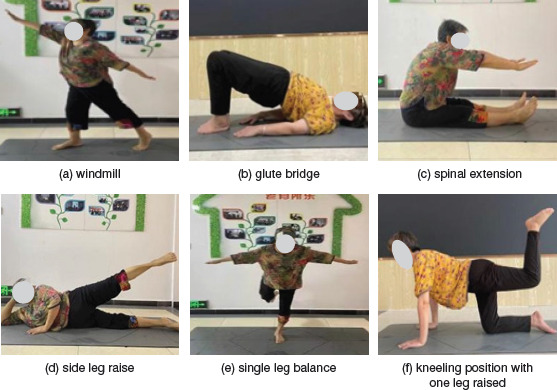
Phase 2 (weeks 5–8) was a period of progressive improvement. Following a gradual progression principle and building on the foundation established in phase one, this stage included movements with larger ranges of motion and various trajectories, increasing the difficulty and requiring some core strength. In this phase, seniors practiced larger and more varied movements, enhancing the nervous system’s control over the muscles, maintaining precision and stability in movements, thereby improving the coordination control of proprioceptors, vestibular organs, and the nervous system. This progression was beneficial for enhancing the elderly participants’ core strength and balance abilities. The Pilates exercise consists of 7 Pilates exercises: (g) prone hip lift, (h) swimming, (i) side leg circles, (j) upper body rotation, (k) simplified the hundred, (l) clamshell, and (m) single leg extension (Figure 2), 6 times per pose for 2 sets with rest of 20 s between sets for a total of 40 min.
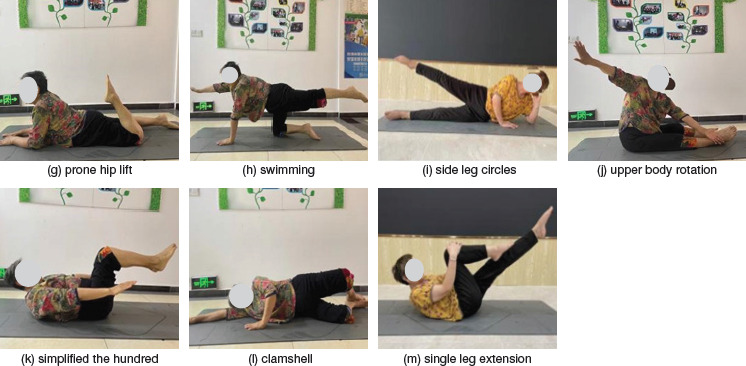
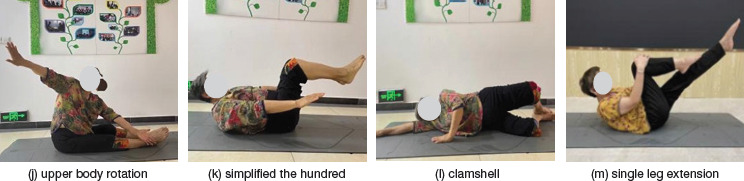
The final phase, or phase 3 (weeks 9–12), was the consolidation and development period. This phase focuses on the movements from phase 2 and includes the single-leg lift from the kneeling position learned in phase one, along with newly added single-leg extension exercises. The practice progressed from small to larger ranges of motion, from single trajectories to multiple trajectories, and from low to moderate loads in compound movements. This further deepened the stimulation of the participants’ muscle and nervous sensory systems, maintaining correct movements and the proper alignment of the kinetic chain, enabling a more fluid and coordinated integration of movement with the body, enhancing the efficiency of the mind–body connection, and promoting a harmonious unification of body, mind, and spirit. This approach helps improve control, balance, and coordination in older adults. The Pilates exercise consists of 4 Pilates exercises: (i) upper body rotation, (k) simplified the hundred, (l) clamshell, and (m) single leg extension (Figure 3), 10 times per pose for 3 sets with rest of 20 s between sets for a total of 40 min.
Pre- and post-experiment data collection was utilised to evaluate static balance testing based on the standing on one leg with eyes closed test from the China National Physical Fitness Measurement Standards, with an additional standing on one leg with eyes open test. The dynamic balance tests included ground balance, beam walking, and the standing up and walking timing test. The activity balance confidence was assessed using the Activity Balance Confidence Scale (ABC Scale).
The static balance test is performed by standing on one leg with eyes closed according to the Chinese National Physical Fitness Standards, which is measured by the subject standing in an anatomical position with the palms facing forward. To prepare, one leg is lifted, and the other is bent at the knee, with the toe touching the ground. When ready, the toe of the bent leg lifts off, and the subject closes their eyes while timing begins. The lifted foot cannot touch anything. Timing stops immediately if the lifted foot contacts the ground, there is noticeable body sway, the support foot moves, or it rolls over.
The standing on one leg with eyes open test is measured by the subject standing with both hands naturally at their sides, eyes open. To prepare, one leg is lifted, and the other is bent at the knee, with the toe touching the ground. When ready, the toe of the bent leg lifts off the ground, and timing begins. The bent leg cannot rest against the standing leg, and the eyes can focus straight ahead. Timing stops immediately if the bent leg touches the ground, the standing leg moves, or if body sway exceeds 15%.
The dynamic balance tests included the ground balance beam walking, and the standing up and walking timing test. The ground balance beam walking test is measured by the participant standing at one end of the balance beam. Upon hearing the command ‘Start’, they immediately begin to walk quickly, and the timing starts at that moment. The participant walks to the other end, turns around, and walks back. Timing stops immediately if the toe of either foot crosses the exit line. The time taken to walk back and forth once on the balance beam is measured.
The standing up and walking timing test is measured with the participant wearing their usual comfortable shoes and sitting upright in a chair with a seat height of 45 cm and arm-rest height of 20 cm, with their back against the chair. A thick line is drawn in front of the chair as the first exit line, and participants must ensure their toes do not cross this line while seated. The second exit line is drawn 3 metres away from the first. When participants hear the command ‘Start’, they stand up and walk 3 metres forward, turning around after crossing the second line, walk back and sit back down in the chair with their back against the backrest. The timer records the time taken for the participant to leave the backrest, walk 3 m forward, turn around, return, and sit back down with their back against the backrest, measured in seconds.
SPSS for Windows (Version 26.0; SPSS, Inc., Chicago, IL, USA) was used for statistical analyses. This study presented a statistical analysis where data were presented as mean ± standard deviation, and the Kolmogorov–Smirnov test was used to verify a normal distribution. A paired t-test was used to compare the outcome variables before and after the experiment within groups. An independent t-test was used to compare outcome variables between groups. Statistical significance was set at p < 0.05.
Results
After the experiment, 5 participants who had dropped out for personal reasons were excluded, leaving 43 elderly individuals for subsequent testing of various indicators, with the experimental group having 21 participants remaining (7 males and 14 females) and the control group having 22 participants remaining (6 males and 16 females). The basic characteristics of the participants showed no difference between groups (Table 2).
Table 2
Basic characteristics of participants
Within-group comparison of the means between before and after the experiment demonstrated that standing on left and right foot with eyes open, standing on left and right foot with eyes closed, ground balance beam walking test, stand-up and walk timing test, and ABC scale index significantly improved in the experimental group (p = 0.001) and were significantly different between groups (p = 0.001, p = 0.001, p = 0.019, p = 0.015, p = 0.022, p = 0.021, and p = 0.043, respectively) (Table 3).
Table 3
Comparison of balance ability and balance confidence within and between experimental and control groups
Discussion
The results of this study indicate that the experimental group experienced a statistically significant improvement in all parameters of balance ability and balance confidence following the Pilates exercise, which was unlike the control group because Pilates is a mind and body exercise that focuses on muscle control, posture, and breathing, which can accelerate the recovery of function in injured bodies, improve body alignment, enhance core strength, and refine coordination and balance [8]. It also improves lumbar bone density [9], positively affects cardiopulmonary function [10], and has a positive effect on static balance ability in the elderly [11]. In addition, past studies have found that elderly individuals aged 60–69 improved their static balance functions through Pilates exercises. Liang [12] showed that the closed-eye single-leg standing time for a square dance group was longer than that of a group practicing the simplified 24-form Tai Chi, indicating that square dance was more effective than Tai Chi in improving static balance in the elderly. According to research by Gao et al. [13], the stability of closed-eye single-leg standing significantly improved in the Pilates group compared to the square dance group. These studies suggest that Pilates may be more applicable than square dance and simplified Tai Chi for enhancing static balance in elderly individuals.
Dynamic balance ability in elderly individuals requires higher demands on visual judgement, muscle strength, joint stability, coordination, and the integration of information from various sensory organs with the nervous system. The improvement in walking speed on the balance beam for elderly individuals aged 60–69 may be related to the physiological and psychological changes resulting from Pilates practice. While performing Pilates movements, elderly individuals consistently activate the central nervous system’s control of body movement, transforming initially unfamiliar Pilates poses into familiar ones, even leading to muscle memory development, thus enhancing the sensitivity and precision of nervous system regulation. For example, during the windmill pose, the elderly stand with their feet positioned one in front of the other, with the front foot fully grounded and the back foot on its toes. The contact area of the body is small, and the arms are extended forward and backward like wheels, causing the waist to twist left and right. Initially, elderly individuals may struggle with coordination and experience instability while practicing the windmill. However, with repeated practice, their control abilities improve, allowing them to perform the movements successfully and enhance both muscle coordination and confidence.
Through Pilates exercises, elderly individuals continuously gain self-awareness, actively engage in exercise and communication, and reduce their fear of physical activity. This psychological adjustment improves the muscle system’s efficiency and exercise confidence, enabling them to maintain body stability even under the challenge of the balance beam. This accelerates walking speed and promotes improvements in dynamic balance ability, which is consistent with the study by Bird and Fell [14], who investigated the effects of a 5-week initial Pilates intervention on fall risk factors over 12 months, finding that elderly individuals exhibited marked improvements in postural sway, dynamic balance, and functionality that were sustained for 12 months. Dugosz-Boś et al. [15] also confirmed the effectiveness of Pilates in improving balance and minimising fall risk among older women [15]. Vieira et al. [16] conducted research that also validated the beneficial effects of Pilates on dynamic balance, leg strength, and fitness.
The Activity Balance Confidence Scale reflects self-assessed balance abilities and is commonly used to evaluate aspects of balance in elderly individuals or patients with illnesses. It often indicates the elderly’s self-awareness regarding their balance confidence and their fear of falling. Falls are a significant psychological factor that instil fear of movement in the elderly. After 12 weeks of Pilates practice, the results of the Activity Balance Confidence Scale showed an optimistic trend, with increased confidence in completing activities they previously hesitated to undertake, whether indoors or outdoors.
Balance ability is directly proportional to activity balance confidence. The better the elderly individuals’ balance, the lower their fear of falling. Conversely, a decline in balance ability causes some concerns before engaging in physical activities, leading to increased vigilance in their environments. As bodily functions gradually decline, muscle strength and the nervous system’s regulatory effects weaken, resulting in stiffness in the limbs, impeded movement, and decreased balance ability, which increases the risk of falls. This fear of falling often escalates, causing elderly individuals to lose confidence, even in tasks within their capabilities. Pilates exercises primarily involve mat-based movements, with a focus on gradual progression and slow speeds, stimulating deep muscles, emphasising body control and precision, activating core strength, and enhancing the nervous system’s regulation over motor functions to improve balance ability in elderly individuals. The study by Kara et al. [17] indicated that Pilates is more effective than aerobic exercise in reducing fatigue and depression in patients with multiple sclerosis. Aibar-Almazán et al. [18] explored the impact of Pilates on fall risk factors in community-dwelling elderly women and found beneficial effects on balance confidence, fear of falling, and postural stability following a 12-week Pilates training program. Hita-Contreras et al. [19] noted that Pilates is considered an effective method for improving physical and psychological aspects related to falls among postmenopausal women, alleviating the fear of falling and depressive states, and improving the quality of life. Bullo et al. [20] also indicated that regular Pilates practice can reduce the risk of depression and promote well-being and independence in the daily activities of the elderly.
In summary, after 12 weeks of Pilates training, the participation of elderly individuals aged 60–69 resulted in significant improvements in the scores on the Activity Balance Confidence Scale (ABC) across various activity items. Participants expressed increased confidence in engaging in related physical activities, likely linked to the confidence gained through Pilates and enhanced social interactions. The improvement in balance ability among elderly individuals aged 60–69 may also correlate with the increase in balance confidence. The enhanced activity balance confidence in the elderly suggests that Pilates has a regulatory effect on mental health, allowing participants to relax and actively manage negative emotions and fears.
Limitations
This study did not use Activity Balance Confidence as an inclusion criterion, which found that older adults already had a high level of confidence. Future studies should include older adults with low or moderate activity confidence to explore whether Pilates can improve confidence in older adults with low or moderate activity confidence.
Conclusions
The findings from the study indicated that Pilates exercises are effective in enhancing both static and dynamic balance abilities among elderly individuals aged 60–69, thus significantly reducing their risk of falls. Meanwhile, balance confidence was also improved after the 12 weeks of Pilates exercise. According to the study’s outcomes, elderly people between the ages of 60 and 69 are able to decrease their risk of falling by performing Pilates exercises to improve their static and dynamic balance skills. Following the 12-week Pilates practice, confidence in their capacity to balance was also enhanced.