
Introduction
Non-communicable diseases (NCDs), also known as chronic non-communicable diseases, are medical conditions that are not transmitted from person to person, progress slowly over time, and typically result from a combination of genetic, physiological, environmental, and behavioural factors [1, 2]. Key examples include cardiovascular diseases (e.g., heart attacks and stroke), cancers, chronic respiratory diseases (e.g., chronic obstructive pulmonary disease), diabetes, hypertension, and obesity, which collectively impose a substantial socio-economic burden through long-term management needs and reduced productivity [1, 2].
According to the World Health Organization (WHO), nearly 25% of the world’s population resides in South Asia, a region undergoing a rapid epidemiological transition characterised by a sharp rise in NCD prevalence and incidence [1, 2]. This shift is driven by urbanisation, dietary changes, and sedentary lifestyles, with NCDs now accounting for approximately two-thirds (66%) of all deaths in the WHO South-East Asia Region, including over 6 million annual deaths in India alone, representing 63% of the country’s total mortality [1–3]. India, the region’s largest nation, bears the heaviest NCD burden, with incidence rates increasing by 3% from 2010 to 2021 despite a slight 1% decline in overall prevalence [4].
Compounding this challenge are profound demographic shifts, including accelerated population ageing. In the SouthEast Asia Region, the proportion of individuals aged 60 years and older is projected to nearly double, rising from 12.2% in 2024 to 22.9% by 2050 [2]. Globally, the number of people aged 65 and older is expected to reach 1.5 billion by 2050, with South Asia facing acute vulnerabilities due to limited healthcare infrastructure and heightened exposure to NCD risk factors like sedentary behaviour [3]. This ageing trajectory exacerbates fall risks and comorbidities in older adults, underscoring the urgent need for targeted rehabilitation strategies [1, 3].
In the context of diabetes, as people age, balance and cognitive dysfunctions often coexist. Chronic hyperglycaemia leads to peripheral neuropathy, affecting proprioceptive feedback from the feet, which is crucial for postural control [5–7]. Vestibular dysfunction, often observed in diabetics, further compromises spatial orientation and equilibrium [5]. Additionally, diabetes-related muscle weakness and reduced joint mobility impair the neuromuscular responses needed for maintaining balance. Cognitive decline, also linked to type 2 diabetes mellitus (T2DM), can disrupt dual-task (DT) balance performance, leading to an increased risk of falls [5, 8]. A key component of evidence-based practice in rehabilitation is the identification of changes in balance performance.
Screening tools for early physical decrement detection can enable the implementation of preventive measures and an appropriate treatment plan to minimise the development of secondary problems, such as decreased physical activity and decreased confidence [9].
It has been illustrated that balance performance during dual-task balance can be a reliable source of information to differentiate between elderly with or without a history of falls [10, 11]. DT assessment programs that address both cognitive function and stability are vital in rehabilitation to promote healthy ageing [11, 12].
The application of digital media and computer technologies provides a number of promising approaches for dual-task assessment and training [12]. These emerging rehabilitation technologies have the potential to improve clinical outcomes by making therapies and exercise more engaging, motivating, and effective, and are also used to assess the decline in balance and mobility [10–12]. In the context of NCDs like T2DM, virtual reality (VR)-based exergames have demonstrated efficacy in improving postural stability and reducing fall risk among older adults with diabetes, with one randomised trial showing significant gains in Berg Balance Scale (BBS) scores after eight weeks of VR training [13]. Similarly, serious digital games focused on self-management and cognitive– motor integration have improved glycemic control, executive function, and adherence in T2DM patients, as evidenced by a scoping review that reported moderate-to-large effect sizes on health behaviours and quality of life [14]. Home-based exergaming platforms combining balance challenges with cognitive tasks have further supported dual-task performance in frail elderly with NCDs, yielding sustained improvements in gait speed and working memory [15].
Unlike standard balance exercises [16–18], the computer game-based rehabilitation platform (CGRP) assessment tool includes a combination of mCTSIB (producing somatosensory disorientation and increased balance demands with the help of a compliant sponge pad) and visuomotor cognitive tasks (continuous visual searching and tracking of moving objects on a computer screen) [11, 19, 20].
The test–retest reliability of the CGRP assessment tool has been established in healthy older adults, stroke patients, children with cerebral palsy, and Parkinson disease patients. However, its applicability in diabetic elderly is limited.
Hence, the primary goal of the present study was to establish the test–retest reliability and discriminant validity of a DT-CGRP that incorporates head tracking (HT) and cognitive game (CG) tasks with balance activities in elderly diabetics to identify risk of falls.
Subjects and methods
Study design
A psychometric, cross-sectional, non-experimental study with repeated measures was performed at the Department of Physiotherapy of a tertiary care hospital from November 2022 to May 2023. Prior to participation, all individuals were provided with detailed information about the purpose, procedures, potential risks, and benefits of the study in a language they could understand.
The form was administered and explained by the principal investigator in a one-on-one setting to ensure that participants had the opportunity to ask questions and clarify doubts. Participation was entirely voluntary, and individuals were informed that they could withdraw from the study at any point without any consequence to their routine care. Participants continued their routine medical management for T2DM throughout the study period.
Sample size calculation
For assessing test–retest reliability, the sample size was calculated based on guidelines for intraclass correlation coefficient (ICC) studies, which recommend considering the expected ICC, the desired precision width of the 95% confidence interval (CI), and the number of repeated measurements. Following the recommendation of Zou [16], the study aimed for a minimum ICC of 0.70 (indicating high reliability) with a 95% CI width of 0.30 (i.e., ± 0.15 around the ICC estimate) and two measurements per participant (day one and day seven). Using the formula for ICC sample size estimation: 8 z2 (1 − 0)2 / (w2×k) + 4 z2 (1 − 0)2 / (k− 1) where, 0 = 0.70 (expected ICC), w = 0.30 (CI width), z = 1.96 (z-score for 95% CI), and k = 2 (number of measurements). The calculation yielded a minimum sample size of approximately 26 participants. To account for potential dropouts and ensure robustness, the study recruited 30 older adults with T2DM for the test–retest reliability analysis.
For discriminant validity, the sample size was determined to detect significant differences in centre of pressure (COP) excursions and traditional balance scales such as the Berg balance scale (BBS), dynamic gait index (DGI), and activities- specific balance confidence (ABC)scale between diabetic and non-diabetic groups using independent t-tests, as well as to evaluate correlations using Spearman’s rho. Using the G*Power software (version 3.1), the calculated sample size for an independent t-test with effect size (d) = 0.8, alpha ( ) = 0.05 (two-tailed), and power (1 − ) = 0.80 yielded a required sample size of 26 participants. For correlation analyses, a sample size of 30 was deemed adequate to detect moderate correlations (Spearman’s rho 0.30) with 80% power, based on guidelines [17].
Eligibility criteria
Forty-five elderly participants aged 60 and above, with adequate hearing and vision to perform computer game activities, MMSE scores of more than 20, and BBS scores ranged between 45 and53 at baseline were included, from which test– retest reliability was performed on 30 elderly T2DM participants. For discriminant validity between the BBS, DGI, ABC, and CGRP measures, 30 elderly participants were categorised into two groups: group 1, consisting of 15 T2DM participants, and group 2, involving 15 age-matched non-diabetics. Subjects with cardiopulmonary dysfunctions (uncontrolled hypertension, cardiac failure), history of neurological or musculoskeletal disorders that can hamper their participation in the tests (e.g., stroke, hip/knee joint surgery/ painful arthritis, and uncorrected visual impairments), and subjects with ulcers or cellulitis of the foot were excluded from the study.
Assessment procedure and outcomes
The test–retest reliability was assessed for the CGRP at two different test periods (day one and day seven). The discriminant validity was assessed by comparing and correlating the BBS, DGI, ABC, and CGRP, which are frequently used functional measures in older populations with and without diabetes. Participants were engaged in a sequence of computerised HT and CG tasks while standing on a sponge and fixed surface (FS). The participants were given explanations regarding the procedure and task demonstrations involved in the outcome measures (CGRP, BBS, DGI, and ABC) [11, 20]. Before commencement of the protocol, demographic information consisting of age, sex, and duration since the diagnosis of T2DM was recorded.
Force sensor array (FSA)
The CGRP included assessment of the standing balance of the participants in the following conditions for 45 s: (a) Quiet standing with eyes open (EO) on an FSA mat (Vista Medicals Ltd, Winnipeg, Canada) which was spread on the ground (firm surface), (b) Quiet standing with eyes closed (EC) on the FSA mat which was spread on the ground (firm surface), (c) Quiet standing with EO on the FSA mat which was spread on a wooden board, which in turn was placed on a sponge surface (SS) of 6-inch height, (d) Quiet standing with EC on a SS. The thick Teflon-embedded FSA mat recorded the COP excursions during standing and was used to calculate the vertical foot COP position for all the tasks. The thin, flexible piezo-resistive FSA pressure mats can be placed on various support surfaces, including sponge pads. The FSA mat (ICC > 0.90) consisted of a 16 × 16 array of 256 piezoresistive sensors, with each sensor covering a surface area of 2.8 cm2. Each sensor was sampled at a frequency of 15 Hz, and the contact forces recorded from the array of sensors were summed to determine the vertical COP in the anterior–posterior(AP) and medial–lateral (ML) directions. The sensors had a resolution of 4,096 levels (12-bit) and were calibrated to 300 mm Hg [10, 11, 20–22]. The FSA mat was connected to a laptop running the FSA software, which recorded the COP displacement. The sequence of visual tracking, CG tasks, and other measures were randomised and unpredictable to the participants.
Following the assessment of standing balance with EO and EC on a firm and soft surface with the FSA, the patients were assessed on the game applications, which required the participants to wear a head cap on which a motion mouse (Gyration, SMK-LINK Electronics, USA) was mounted. The motion mouse was attached to the headband by Velcro, enabling head rotation to control the movement of the on-screen cursor. This easy technique enables hands-free, all-in-one-place responsive interaction with most computer programs [20, 22]. This mouse functions similarly to a standard computer mouse and employs inertial sensors to generate angular displacement signals. By performing the rotation of the head, the participants controlled the on-screen user cursor movements. The interactive computer game application consisted of two assessment modules: the head tracking (HT) module (tracking the ability to follow the target cursor on the screen) and the CG module (for evaluating the ability to catch targets falling vertically from the top of the screen) [20–22].
Head tracking (HT) module: The objective of the HT module was to keep two objects overlapping for 45 s. A bright circular object, which was controlled by the computer, moved vertically (up and down) and horizontally (left and right) in a cyclic motion on the computer display for 45 s. The amplitude was 70% of the width of the monitor, and the motion frequency was 0.5 Hz. The second object, a square, was controlled by the participant’s head rotation movement by using the head-mounted motion-sensing mouse [21]. During the HT task, the participants were instructed to move the head- controlled cursor and overlap it with the moving ‘target cursor’ that was controlled by the computer. At a viewing distance of 100 cm, the task required head rotation of 80 degrees to move the cursor from the left edge to the right edge of the monitor. The participants performed the HT tasks for 45 s while standing on both a fixed and solid surface. The computer application logged data to a file at 100 Hz to record the coordinates of the square (head rotation) and circle (target) objects. The data file was processed offline to measure visuo-motor performance.
Cognitive game (CG) module: The goal of the CG was to move a paddle to interact with moving objects that had pre- programmed speeds. During this task, the participants performed head rotation through mouse motion to move the game paddle. In this game, the head rotation movement of the participants (paddle) was observed when the target was falling down on the screen. In this task, the participant was given a single target that was displayed at the top of the screen and moved vertically downwards while they moved the game paddle and caught the circular target object, which required them to rotate their head. This was performed while standing for 60 s on a fixed and solid surface. The task complexity varied from simple, with a single target moving in a straight path, to more challenging, with additional targets moving diagonally and distractor objects to avoid. The data logged to a file by the application were recorded synchronously at an 80 Hz sampling rate [11, 22].
Data analysis
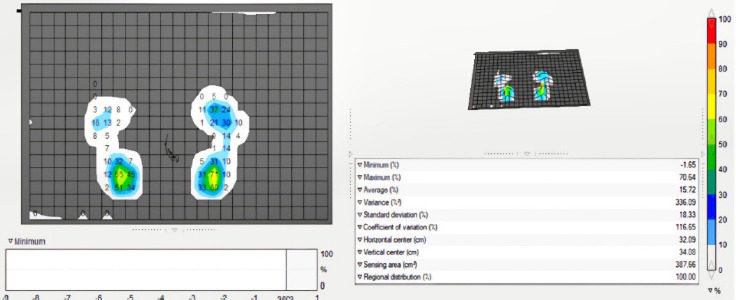
Standing balance: Figure 1 displays an example of the foot pressure (right and left) distribution recorded via the FSA pressure mat during various standing tasks, with values colour- coded (blue – lowest, red – highest). The black marking represents the COP, tracked in real time and mapped to control the game sprite cursor, enabling interactive balance assessment [are prognostic of future adverse health events, including fall injuries. Consequently, dual-task assessment programs that simultaneously address both stability and cognition are important to consider in rehabilitation and benefit healthy aging. The objective of this study was to establish test-retest reliability and construct validity of a dual-task computer game- based platform (TGP21].
Figure 1
Analysis of the left and right foot centre of pressure excursions while standing on an force sensor array pressure mat (FSA mat.). Snapshot of the left and right foot while standing on a fixed-surface FSA mat. XY plot of centre of pressure excursions during stand-alone condition
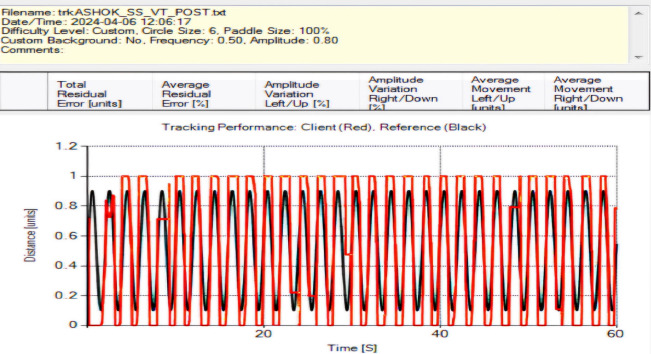
HT performance measures: Figure 2 evaluates head rotation (via HT) quality by comparing user signals (red) with reference signals (black). The user’s head movements, tracked via a head mouse, are assessed against the reference cursor. Sinusoidal waveforms indicate tracking accuracy, providing feedback on movement coordination.
Figure 2
Head tracking evaluates head rotation quality by comparing user signals (red) with reference signals (black)
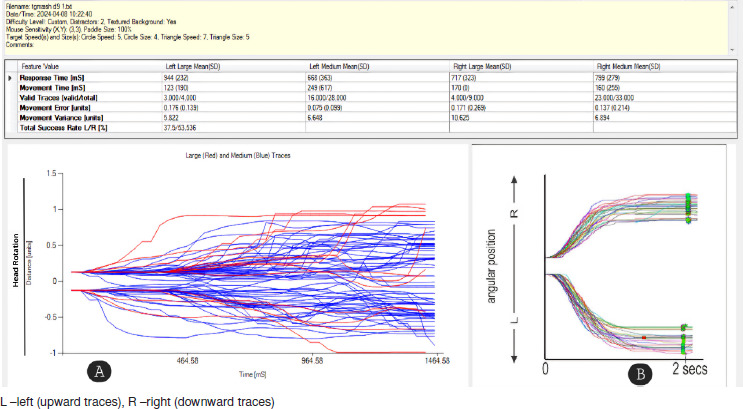
CG performance measures: Figure 3 depicts head rotation trajectories (game paddle movements) during the CG task over 120 s. Each target event lasted 2 s, totalling 60 recorded events. The timing and characteristics of these segmented movements were analysed to quantify cognitive functions.
Figure 3
Head rotation trajectory during the cognitive game task: (A) Individual segmented game events overlay plots of head rotation trajectories, (B) As shown in A, the segmented game events were sorted by amplitude and direction and same movements were grouped into one plot
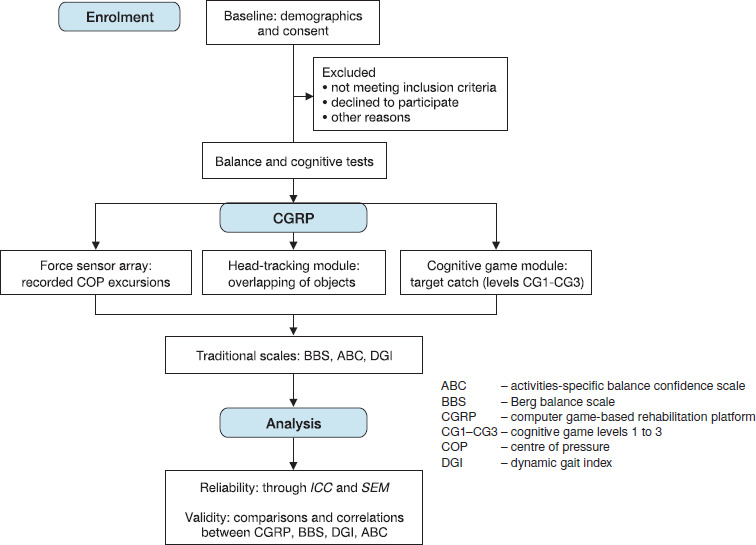
Additionally, the functional measures to evaluate balance included the BBS, which was used to determine the static balance and the risk of falling in elderly participants, consists of 14 items, with each item scored from 0 to 4 points, with a maximum score of 56 signifying good balance [23]. DGI evaluated the dynamic balance during walking, which consisted of eight items, and each item was scored from 0 to 3 points, with a maximum score of 24 signifying a greater degree of independent functional mobility [23]. The ABC scale represented a wider spectrum of challenges while performing activities, and consists of 16items that were rated from 0% depicting no confidence at all to 100% demonstrating absolute confidence [18, 19]. The flowchart for the procedure is illustrated in Figure 4.
The relative intrarater reliability of the BBS was high, with a pooled estimate of 0.98 (95% CI 0.97 to 0.99) along with a relative inter-rater reliability with a pooled estimate of 0.97 (95% CI 0.96 to 0.98). Moreover, the validity for fall risk identification in older adults with T2DM was 0.76 [24, 25]. Additionally, the DGI demonstrates good reliability [26] (ICCs for test–retest = 0.96 and interrater reliability = 0.96); along with the ABC (ICC = 0.879), for which the internal consistency measured by Cronbach’s was 0.973 [27]. For the CGRP, the FSA reliably measures postural sway (ICC > 0.90). Prior validation in older adults shows high test–retest reliability (ICC = 0.82–0.98) and construct validity for balance–cognition interactions [20, 24].
To promote adherence in this elderly cohort, several participant-centred strategies were implemented. Scheduling flexibility was prioritised, allowing sessions to be arranged at convenient times (e.g., mornings to avoid fatigue). A dedicated study coordinator conducted phone reminders 48 h prior to each session and follow-up calls on day 3–4 to confirm availability and address barriers.
Statistical analysis
SPSS version 22 for Windows was used for statistical analyses, and descriptive statistics were calculated for each outcome measure, includingthe median and interquartile range (IQR). These were used to summarise the central tendency and variability of the data across different test conditions. A two-way random model was used to assess the relative reliability, measuring the consistency of CGRP measurements between two test sessions (day one and day seven). ICC scores were interpreted as: high: 0.70, moderate: 0.50–0.69, and low: < 0.50;whereas absolute reliability was assessed using the standard error of measurement(SEM),indicating the precision of the measurements. Minimal detectable change (MDC) was calculated to identify the smallest statistically significant change in scores, enhancing clinical interpretation. Wilcoxon signed-rank tests assessed systematic errors between test sessions, replacing paired t-tests due to non-normality.
Discriminant validity was evaluated using Spearman’s correlation between CGRP outcomes and conventional scales (BBS, DGI, ABC), with correlations interpreted as excellent ( 0.60), moderate (0.30–0.60), or low (< 0.30). Mann–Whitney U tests compared diabetic and non-diabetic groups, replacing independent t-tests due to non-normality and heteroscedasticity.
A p-value 0.05 was considered statistically significant. The specific variables, all related to balance assessment, directly relate to balance assessment as they measure COP excursions, which reflect postural stability and sway under different sensory and cognitive demands. The CGRP tasks (HT and CG) integrate DT conditions (Table 1), combining balance with cognitive and visuomotor activities, which are critical for assessing fall risk in elderly populations with T2DM. The test–retest analysis evaluated the consistency of these COP excursion measurements across two sessions (day one and day seven), with results showing high ICC values (0.82– 0.98), indicating reliable balance assessment.
Table 1
Test–retest reliability of COP excursions and cognitive performance measures in older adults with T2DM
Results
Test–retest reliability
Overall, 30 elderly participants with T2DM were included (24 males and 6 females) in the current study. The mean age of the participants and the mean time period since diagnosis of T2DM was 68.92 ± 2.90 years and 7.3 ± 3.1 years, respectively. The test–retest analysis of COP excursions, MDC, and cognitive performance for various conditions is reported in Table 1.The study adheres to COSMIN standards [28] by assessing test–retest reliability with two measurements (day one and day seven, n = 30), a suitable interval ensuring stable conditions, as no intervention was applied. Table 1 refers to the Wilcoxon signed-rank test p-values to compare median COP excursions and evaluate systematic errors between the two test sessions (day one and day seven) for each condition. The non-significant results (NS, p > 0.05) indicate no systematic differences in mean COP excursions, supporting the reliability of the CGRP.
The MDC values on the CGRP ranged from 21.62 to 49.34, which depicts the smallest amount of change that can be considered statistically significant. In clinical or rehabilitation settings, improvements in balance or cognitive performance that exceed the MDC threshold can be confidently interpreted as real or significant changes [29]. The ICC scores between 0.82 and 0.98 indicated a high level of test–retest reliability. However, the results were statistically insignificant between the two test periods. Additionally, based on the Wilcoxon signed-rank analysis between the test sessions, no systematic errors were observed in the COP displacement measures.
Discriminant validity
Overall, 30 elderly participants were included (14 females and 16 males) and divided into two groups (group 1 – diabetic elderly, group 2 – age-matched non-diabetics). The mean age of all the participants was 66.92 ± 6.21 years, and the mean time period since diagnosis of T2DM in group 1 participants was 15.10 ± 10.30 years. The demographic information of diabetic and non-diabetic participants is reported in Table 2.
Table 2
Demographic and baseline characteristics of diabetic and non-diabetic participants
| Characteristic | Diabetic group (n = 15) | Non-diabetic group (n = 15) | Test value | p-value |
|---|---|---|---|---|
| Age (years, mean ± SD) | 66.20 ± 3.33 | 61.50 ± 4.46 | t = 3.27 | 0.0028* |
| Sex (n, male/female) | 8/7 | 8/7 | 2 = 0 | 1.0 |
The results reported in Table 3 showthat on ABC scores, and while standing on a SS with EC during theCGRP, the COP excursion measures increased significantly. All comparisons used baseline (day one) data and Mann–Whitney U-tests.
Table 3
Comparison between BBS, DGI, ABC, and CGRP scores in elderly participants with and without diabetes.
The upper and lower range represents 95% CI values
Shapiro–Wilk tests confirmed non-normality (p < 0.05) for the DGI, ABC (non-diabetic), and COP measures, with BBS and SSEC (non-diabetic) borderline (p 0.07–0.12). Levene’s tests (p < 0.05) indicated heteroscedasticity, justifying Spear-man’s rho for correlations.
The correlation between the BBS, DGI, and ABC with the CGRP is demonstrated in Table 4. The correlation values varied from −0.372 to 0.455, reporting a weak correlation, which shows that the outcome measures included must be measuring different aspects of balance [30]. However, the results were statistically insignificant.
Table 4
Correlations between BBS, DGI, ABC and CGRP in elderly participants
[i] ABC –activities-specific balance confidence scale
BBS – Berg balance scale
CGRP – computer game-based rehabilitation platform
DGI – dynamic gait index
FSCG1 – fixed surface cognitive game level 1
FSCG2 – fixed surface cognitive game level 2
FSCG3 – fixed surface cognitive game level 3
FSEC – fixed surface eyes closed
FSEO – fixed surface eyes open
SSCG1 – sponge surface cognitive game level 1
SSCG2 – sponge surface cognitive game level 2
SSCG3 – sponge surface cognitive game level 3
SSEC – sponge surface eyes closed
SSEO – sponge surface eyes open
p > 0.05 – not significant
The non-parametric correlation within various constructs of the CGRP is reported in Table 5. An increase in COP excursion on a fixed surface corresponds to a rise in COP excursion on a SS. Similarly, higher levels of CG lead to greater excursion. This indicates a moderate to strong correlation within the CGRP constructs.
Table 5
Non-parametric correlations within various constructs of the CGRP
Discussion
This study establishes the test–retest reliability and discriminant validity of a CGRP for assessing dual-task balance and cognition in older adults with T2DM. Primary findings include excellent relative reliability across various conditions with no systematic errors in stable tasks, alongside acceptable absolute reliability. For discriminant validity, weak correlations with traditional scales (BBS, DGI, ABC) confirmed the CGRP’s unique capture of motor–cognitive interactions, which were particularly weaker in T2DM. Significant group differences emerged in ABC scores and sponge surface eyes-closed COP excursions, with diabetics showing reduced confidence and greater sway. These results position the CGRP as a reliable, valid tool for fall risk screening, prompting further exploration of its clinical utility below.
Test–retest reliability
The current research demonstrates the effectiveness of the CGRP as an assessment tool. The high ICC scores and absence of systematic errors illustrates that the CGRP can consistently document reliable data from elderly diabetics. The future aim of the research is to evaluate the impact of computer game-based rehabilitation (CGBR) on an individual’s balance performance. Without the confidence that the measure chosen is reliable, it is difficult to ascertain whether differences in performance pre- and post-intervention are genuinely due to the intervention provided and not an artefact of the tool. In the present study, the ICC scores between 0.82 and 0.98 indicated a high level of test–retest reliability, and the results were statistically insignificant between the two test periods. The results also reported that tasks involving dual- tasking (such as balance combined with cognitive tasks) tend to have higher MDC values. For example, FS-CG2 and SS-EO showed the largest MDC values, meaning these tasks introduce greater variability and therefore require larger changes to be considered significant. Hence, dual-tasking (head-tracking with CG) presents a more complex challenge to participants, which is reflected in higher MDC values. Moreover, SS tasks generally exhibited higher MDC values compared to FS tasks. For instance, SS-EO is higher than FS-EO. This indicates that tasks on unstable surfaces, like standing on a sponge surface, introduce more variability in postural control, leading to a greater threshold for detecting significant improvements. A previous study by Bhatt et al. [10] reported that high MDC values require more change from pre-to post-intervention to be considered significant and demonstrate the efficacy of the program.
An increase in COP excursion and a decrease in cognitive performance measures were observed in the present study. The extent of COP displacement was also influenced by the varying difficulty levels between visual CG with and without a distractor. This reflects the impact of the DT conditions on balance performance. A previous study also observed increased COP displacement while standing and executing tasks involving backward counting, digital span recall [31], and verbal fluency [32]. Recent studies in children and adults show that movement is a blending of reflexive and voluntary control, which is dependent on the demands of the environment or the task in which the individual is engaged [33]. A key feature of the CGRP is its ability to assess the level of involvement in DT conditions and offer valuable insights related to the DT effects on balance across various levels and types of information processing loads.
A previous study demonstrated high ICC values when participants with either their EO or EC stood on a FS [34]. Equivalent values were observed for SS measures [35], which correlates well with the outcomes of the present research, which reported high ICC values for all the conditions along with HT and CG tasks. However, lower ICC reliability values were observed in other studies for standing balance performance as there was an increase in the task difficulty levels [36, 37]. Several studies have shown that distorting or eliminating two sensory inputs, such as EC and SS conditions, often leads to significant increases in balance loss and body sway in older adults [20]. Desai et al. [11] investigated standing balance among an elderly population with and without a previous history of falls. The fallers group displayed higher COP displacements and a higher incidence of balance loss in comparison to the non-fallers group when evaluated on an unstable SS; however, no difference was observed on a FS [11]. The current outcomes elaborate on these results and show that, with the inclusion of the HT and CG tasks, the COP excursions were increased significantly in addition to the SSEC condition. Similarly, previous investigations have also stated an increase in COP excursions when individuals engage in CG tasks that do not involve head movements [38–40].
Rine et al. [41] analysed dynamic visual acuity (DVA) gaming (digital version) while participants were engaged in active repetitive rotations of the head and validated the results by using feedback from a head-mounted inertial motion monitor. A moderate level of test–retest reliability was observed for the DVA test while sitting [41]. Studies have indicated that tracking moving objects becomes more challenging during head movements and when the targets travel long distances at speeds near 1000 s–1 [32]. The current outcomes of the study demonstrating high ICC scores broaden the scope to incorporate visual targets that are moving and situations of standing on a SS, which leads to higher levels of body sway. Several DT studies concentrated on cognitive activities, but there is limited research on the impact of DT on visual–spatial processing tasks. Tasks involving visual search for objects, along with processing their locations and their spatial relations with the body and other objects, are crucial for maintaining balance and are cognitive factors that influence the risk of falls [21]. In the present investigation, a visual–spatial CG activity was utilised to investigate the DT effect, for which the results reported high test–retest reliabilities. Combined analyses of gaze, cognition, and balance will enhance knowledge of the functional impacts caused by the decrease in mental and physical abilities associated with ageing, and the early onset of disease.
Discriminant validity
The second objective focused on discriminant validity between the CGRP and performance-based scales (BBS, DGI, and ABC). The demographic analysis revealed a significant age difference between the diabetic and non-diabetic groups, which may contribute to the observed differences in balance impairments and fall risk, as increasing age is associated with a higher risk of falls due to declines in sensory and physical functions [42]. This age disparity could act as a confounding factor in interpreting group differences, emphasising the need for stricter age-matching in future studies. Regarding sex, the groups were balanced, but the overall sample for discriminant validity was slightly unequal, potentially introducing a risk of sex-based bias. Women tend to have a higher risk of falls compared to men, possibly due to factors such as reduced muscle strength and balance [42]. Additionally, older adults with dementia or cognitive impairment face an elevated fall risk, as cognitive decline reduces gait stability and environmental adaptability [42]. Although the current study excluded participants with severe cognitive impairment, these findings from Li et al. [42] suggest that sex and cognitive status should be considered in fall risk assessments, and future research should stratify analyses by sex to mitigate potential biases.
The discriminant validity confirms that the scale is distinct from other similar concepts and is tested empirically through correlations between the measures. However, in the present study, the summated scale correlates with a conceptually distinct but similar measure. Hence, when thecor-relation is low, it can be concluded that the summated scale differs from the other related ideas by a sufficient amount [43]. The findings of the present study illustrated r values demonstrating a weak correlation, which represents that the outcome measures included must be measuring different aspects of balance [32, 41, 43]. However, within various constructs of the CGRP, moderate to strong correlations were observed as increased COP excursion on FS also increased COP excursion on SS.
The results demonstrated anon-normal distribution, which is common in studies involving elderly populations due to variability in physiological and functional capacities. These findings highlight the heterogeneity of balance performance, especially on the novel game-based protocol in this age group. This issue was addressed by using non-parametric statistical methods. Regarding sample size, the presence of heteroscedasticity reinforces the need for larger samples in future studies to ensure adequate statistical power and generalis-ability. While our study was limited to a smaller sample due to feasibility constraints, it nevertheless provides preliminary evidence that can inform future larger-scale investigations and sample size planning.
The decline in BBS scores in elderly diabetics could be due to polyneuropathy, predominantly because of sensory neuropathy, which in turn is associated with postural instability. In addition, factors such as polypharmacy and reduced speed of cognitive processing involved in controlling balance could have led to reduced balance in diabetic elderly participants [present case-control study was designed to test the ability of two fourteen DPN patients and healthy people to control functional balance using Berg Balance Scale (BBS34]. DGI scores were not significantly affected in the diabetic elderly and age-matched elderly, and both groups scored well on the test. This may be because the DGI is especially beneficial for participants with suspected vestibular disorders, as it includes various head rotation movements that primarily challenge vestibular responses during gait activities [34].The participants demonstrated a significant reduction in the ABC scale, indicating lower confidence while walking in crowded areas and outdoors. This decline may be attributed to diabetic neuropathy, which affects balance and stability, making individuals with diabetes less confident compared to non-diabetics [44].
Moreover, in comparison to the age-matched non-diabetics, COP excursion increased while standing on sponge and executing CG task in elderly diabetics. This suggests that as physical and visual task loads increase, maintaining balance becomes more challenging, leading to greater COP excursions [36, 37, 40]. When individuals engage in visual tasks on a SS while standing, the sensory systems are challenged. The interaction effect shows that as ground reaction force distortion increases, body sway also increases, leading to greater COP excursions to maintain balance [22]. When the visual tasks were performed, there was a significant increase in the COP excursions. A significant interaction effect for COP excursions during the CG task was observed, indicating that the increase in physical load significantly affected COP excursions by enhancing body sway.
Neurodegeneration related to diabetes has been linked to a greater risk of developing vascular dementia and Alzheimer’s disease, which can lead to a significant decline in cognition [39]. Brain imaging studies have shown that the decrease in executive functions related to diabetes is linked to abnormalities in the prefrontal cortex and subcortical regions [45]. Moreover, inadequate glycaemic control has been associated with a four-times-higher risk of mild cognitive impairment in elderly individuals with T2DM [38]. The outcomes of the present research correspond with a previous study, which demonstrated that participants struggled to track moving objects during walking, as coordinating head movement with a falling target while recognising one’s spatial position during walking relies on the same sensory system [39]. Thus, in conclusion, the CGRP offers a robust and objective assessment of balance and cognition and their effect on gait in elderly participants with T2DM.
The CGRP offers a versatile, standardised, and engaging platform for assessing and potentially improving balance and cognitive function in older adults with T2DM, with broader implications for digital evaluation and rehabilitation. For assessment, the CGRP’s ability to reliably measure centre of pressure (COP) excursions under dual-task (DT) conditions (e.g., head tracking and cognitive games on fixed and sponge surfaces) allows clinicians to objectively evaluate motor–cognitive interactions, which are critical predictors of fall risk. Its high test–retest reliability and ability to capture subtle balance impairments, as evidenced by the increased COP excursions in diabetic participants, make it a valuable screening tool for identifying individuals at risk of falls in clinical settings, such as physiotherapy clinics or community health centres. Unlike traditional scales (e.g., BBS, DGI, ABC), which showed weak correlations with CGRP outcomes, the CGRP uniquely assesses DT performance, providing insights into real-world scenarios where cognitive and motor demands coexist, such as walking while navigating obstacles.
For interventions, the CGRP’s gamified approach, incorporating interactive head tracking and cognitive tasks can be adapted for rehabilitation programs to enhance balance, visuomotor coordination, and executive function. The platform’s engaging nature may improve patient adherence compared to conventional exercises, as supported by prior studies on CGBR for conditions like stroke and Parkinson’s disease [10, 20]. By adjusting the task complexity (e.g., CG1 to CG3 with increasing distractors), therapists can tailor interventions to individual needs, progressively challenging patients to improve postural control and cognitive processing. The CGRP’s digital interface, using force sensor arrays and motion-sensing technology, allows for real-time feedback and data logging, enabling clinicians to monitor progress and adjust treatment plans dynamically. Potential applications include integration into telerehabilitation platforms, where patients can perform CGRP tasks at home under remote supervision, and addressing barriers to access in underserved populations.
Future applications could extend beyond T2DM to other populations with balance and cognitive impairments, such as those with neurological conditions (e.g., Parkinson’s disease, multiple sclerosis) or post-stroke deficits, given the platform’s established reliability in similar contexts [10, 20]. The CGRP could also be used in preventive programs for healthy older adults to maintain balance and reduce fall risk. Longitudinal studies are needed to evaluate the efficacy of CGRP-based interventions in improving clinical outcomes, such as reducing fall incidence or enhancing functional mobility. The platform’s adaptability also supports its potential integration with wearable sensors or virtual reality systems to create immersive rehabilitation environments, further enhancing its utility in digital health.
Strengths and limitations
This study advances the CGRP’s feasibility beyond prior tools by enabling individualised or combined assessments of balance, stability, tracking, and executive cognition under DT conditions, elucidating functional impacts of ageing-related motor–cognitive declines in diabetic elderly. Limitations include the small sample, which restricts the generalisability; hence future studies should include younger T2DM adults. The one-week test–retest interval limits long-term stability insights; hence longer follow-ups are warranted. The slight sex imbalance (more males) risks bias, as females report falls more often; hence stratified analyses by sex and cognitive status in larger cohorts would mitigate this. The omission of BMI overlooks adiposity’s effects on balance, so this should be included as a covariate in the future. Non-normal distributions and heteroscedasticity were robustly handled via non- parametric methods, but future power calculations should adjust for skewness to avoid underpowering.
Conclusions
The CGRP was demonstrated to be a valid, reliable, and sensitive framework for assessing the stability, standing balance, and CG task in an elderly diabetic population under single- and dual-task settings. In elderly diabetics, during DT performance while standing on the SS, the COP displacement increased significantly in comparison to FS, which consequently increases the risk of falls. These findings successfully establish that the CGRP should be routinely used for fall risk assessment, as a screening tool, as a preventative measure, and for the purpose of rehabilitation in clinical settings or community centres.