
Introduction
‘Text neck’ is a collective name for an overuse syndrome or repetitive strain injury that develops when a person bows or crouches with their head bowed down and rounded while reading messages or content on an electronic device such as a smartphone. Dr. Dean L. Fishman, a chiropractor from the United States, is identified as the expert responsible for coining the term ‘text neck’ [1]. Text neck syndrome, leading to persistent discomfort in the neck and upper back, can be considered the ‘Pain of the Modern Era’, as it is triggered by contemporary technology such as computers, mobile phones, and other smart devices [2].
The anatomy of the cervical spine, known as the neck, is complex. The muscles, bones, nerves, and spinal cord are organised in a synchronised network. Nerve compression can lead to shoulder and neck pain [3]. According to estimates, 79% of people between the ages of 18 and 44 have their phones with them at all times, with the exception of two hours when they go for walks [4]. With the development of mobile technology in the twenty-first century, an increasing number of individuals are connecting with smartphones on a regular basis. This causes a prolonged flexion of the neck, which leads to text neck [5].
Text neck syndrome (TNS) frequently causes soreness and neck aches as symptoms. Relentlessly fixing one’s eyes to look down at a smartphone all day long may result in the following symptoms and indicators: upper back discomfort can range from a persistent nagging ache to an acute, excruciating agony [6], muscle spasms and shoulder pain caused by tightness in and around the shoulder joint, and chronic spams in the neck that may cause neurological symptoms because the cervical nerves become pinched between the vertebrae, including discomfort that radiates down the arm and forearms [7]. Over the past ten years, there has been a noticeable increase in this public health issue. Its prevalence in late adolescence is comparable to that of low back pain in adults and is at least as high [8]. Users who use smart-phones and tablets frequently run the risk of experiencing muscular fatigue and neck movement restriction. Their ability to work gradually diminishes because of this, caused by the persistent exhaustion of the occipital muscular tissue, which at some point during muscle contractions leads to the production of metabolites that change the stability by activating tonic gamma motor neurons [9].
Thomas Bowen (1916–1982) was the first person to describe Bowen therapy in Australia. This pleasant, calming, and all-encompassing myofascial release is a non-invasive method that involves precise patterns of light cross-fibre movements across fascia, ligaments, tendons, and muscles [10]. By exerting impact on the constricted fascia layer with gradual and continuous force, the movements correspond to a few grams of force. In addition to promoting tissue healing in the regions that were hurt, reducing pain and tension, regaining bodily function, and easing the accompanying mental strain, the force will stimulate or improve blood and lymph flow. There have been no reports of negative effects because it is a gentle and non-invasive procedure [11].
Myofascial release therapy is a manual method designed to alleviate tension and limitations in the fascia, a connective tissue that envelops and provides support to muscles, bones, and organs in the body [12]. Fascia can tighten or become constricted because of injury, overuse, incorrect posture, or trauma, causing pain, rigidity, and reduced mobility. Myofascial release treatment focuses on specific regions of tension to enhance mobility, alleviate pain, and improve general function [13].
According to the literature, no studies have been conducted to compare the outcomes of different approaches for treating text neck syndrome. Therefore, the aim of this randomised controlled trial (RCT) is to evaluate the effects of the myofascial release method and Bowen therapy on individuals with text neck syndrome. The findings will enhance clinical decision- making and inform treatment strategies, enabling healthcare professionals to deliver optimal care for those suffering from text neck syndrome.
The objective of this study was to compare the effects of myofascial release and Bowen therapy on pain, range of motion, disability, and posture in patients with text neck syndrome.
Hypothesis
Null hypothesis
There is no difference between the effects of myofascial release and Bowen therapy on pain, range of motion, disability, or posture in patients with text neck syndrome.
Alternate hypothesis
There is a difference between the effects of myofascial release and Bowen therapy on pain, range of motion, disability, and posture in patients with text neck syndrome.
The stated hypotheses were tested using mixed analysis of variance (Mixed ANOVA). The statistical significance level was set at p < 0.05. The null hypothesis was rejected in cases where a significant difference was found between groups.
Subjects and methods
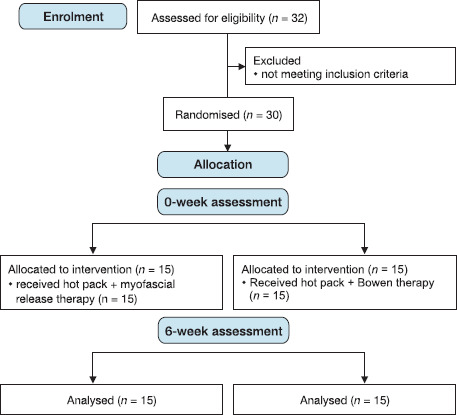
This randomised clinical trial study was performed using a non-probability purposive sampling technique. After obtaining consent, participants were randomly allocated into two groups (control group and experimental group) using a computer-generated random number method and analyzed as per CONSORT (Figure 1). A sample size of 32 was allocated, with 16 participants in each group. The study was conducted at the University of Lahore Teaching Hospital, Lahore between July 2023 and December 2023. Informed consent forms were taken from all participants.
Selection criteria
Participants were allocated to two groups. Group A included myofascial release therapy, while group B included Bowen therapy. The inclusion criteria were that both male and female participants aged 18 to 35 years, using smartphones more than 2 hours per day, and with a history of neck pain for at least 3 months were included. The exclusion criteria were patients who had spinal inflammation or infection, a history of neck surgery, torticollis, or disc herniation. Data were collected using the Numerical Pain Rating Scale (NPRS) to measure pain intensity, the Neck Disability Index (NDI) for measurement of neck disability, and an inclinometer to measure neck ROM, while postural assessment was carried out by using the craniovertebral angle to identify forward head posture using the ImageJ software (ImageJ, National Institutes of Health, Bethesda, MD, USA) for image calibration and quantitative analysis.
Allocation
Group A comprised 15 individuals who underwent myofascial release therapy as part of their treatment plan. During the first and second weeks, group A participants received moist heat for 10 min then myofascial release treatment sessions (a deep transverse friction massage therapist worked on the ulnar borders of both palms to release the cervical fascia, specifically the levator scapulae, sternocleidomastoid, upper trapezius, scalene, and suboccipital muscles) lasting 20 min each. The therapy was repeated in weeks 3 and 4, with the participants continuing to undergo 20-min sessions of myofascial release therapy. During weeks 5 and 6, group A participants received 10 min of moist heating following 20-min myofascial release treatment sessions. Group B consisted of 15 participants who were assigned Bowen therapy as their treatment (The skin was engaged laterally or medially after the fingers were first placed on the starting point with the least amount of pressure. The tissue was then depressed by applying downward pressure, which was maintained for three to four seconds in order to challenge the target tissue to release the cervical fascia, specifically the levator scapulae, sterno-cleidomastoid, upper trapezius, scalene, and suboccipital muscles).
During the first two weeks, group B participants received 10 min of moist heating following Bowen therapy sessions that were 20 min long. The treatment schedule was repeated throughout weeks 3 and 4, with subjects undergoing 10 min of moist heating following 20-min Bowen therapy sessions. In weeks 5 and 6, group B participants had 10 min of moist heating following 20-min Bowen therapy sessions, maintaining continuity.
Data analysis
Data input and analysis were conducted using SPSS version 25, with statistical significance defined as p < 0.05. The Shapiro–Wilk test was used to analyse normality and determine if the data adhered to a parametric or non-parametric distribution. Descriptive statistics were used to summarise the measurements collected from different groups across time. Paired samples t-tests were used to evaluate differences within groups across different time points. An independent t-test was used to assess differences in means between two separate groups.
Results
Table 1 represents the descriptive statistics of distribution of sex and age between groups. In Table 2 for the NPRS measure, there is a statistically significant decrease in pain scores from pre-treatment to post-treatment, with a p-value of 0.022. However, for the NDI, there is no statistically significant difference between pre-treatment and post-treatment, with a p-value of 0.775.
Table 1
Distribution of sex and age between both groups
| Group A | Group B | ||||
|---|---|---|---|---|---|
| sex | n (%) | age range (years) | sex | n (%) | age range (years) |
| male | 9 (60) | 18–35 | male | 10 (33.3) | 18–35 |
| female | 6 (40) | 18–35 | female | 5 (66.7) | 18–35 |
| total | 15 (100) | total | 15 (100) | ||
Table 2
Paired samples t-test between NPRS and NDI of myofascial release group
| Study group | Paired difference | ||
|---|---|---|---|
| mean ± SD | p-value | ||
| Myofascial release group | pre-NPRS score | 3.5625 ± 0.51235 | 0.022 |
| post-NPRS score | 2.8750 ± 0.71880 | ||
| pre-NDI score | 3.0625 ± 0.68007 | 0.775 | |
| post-NDI score | 2.5000 ± 0.63246 | ||
Table 3
Paired samples t-test between before and after treatment for range of motion of the neck in myofascial release group
The results of the myofascial release group are shown in Table 4, for which a paired samples t-test was conducted to compare various inclinometer measurements before and after treatment. The results showed significant differences (p < 0.000) in all measured parameters. These findings suggest that myofascial release treatment had a positive impact on the cervical range of motion in the study group.
Table 4
Paired samples t-test before and after treatment for NRPS in the Bowen therapy group
| Study group | Paired difference | ||
|---|---|---|---|
| mean ± SD | p-value | ||
| Bowen therapy | pre-NPRS | 3.5625 ± 0.51235 | 0.000 |
| post-NPRS | 1.5625 ± 0.51235 | ||
| Bowen therapy | pre-NDI | 3.1875 ± 0.65511 | 0.000 |
| post-NDI | 1.6875 ± 0.60208 | ||
Table 4 shows the paired differences, in which there is a statistically significant decrease in NPRS scores from pre- treatment to post-treatment, with a p-value of 0.000. Similarly, for the NDI, there is a statistically significant decrease from pre-treatment to post-treatment, with a p-value of 0.000.
Table 5 shows the results of the Bowen therapy group, in which paired samples t-tests were conducted to assess the differences in cervical movements using an inclinometer before and after treatment. The results showed significant improvements (p < 0.000) in all assessed parameters.
Table 5
Paired samples t-test between inclinometer of Bowen therapy
Discussion
The results of the current study show the two study groups – the myofascial release group and the Bowen therapy group – each consisting of 15 participants, making a total of 30 individuals. Group A consisted of 15 participants with a mean age of 27.26 and a standard deviation of 4.21 years, while group B was made up of 15 participants with a mean age of 28.73 and a standard deviation of 4.52 years. The sex distribution across both groups comprises 33.3% males and 66.7% females. According to the paired differences, the analysis within the myofascial release group indicates a significant decrease in NPRS scores but no significant change in NDI scores. In contrast, the Bowen therapy group shows significant reductions in both NPRS and NDI scores from pre- to post-treatment (0.000).
The study aimed to assess the impact of the myofascial release technique with and without Bowen therapy on persons with text neck syndrome. The study concentrated on assessing pain levels with the NPRS, functional status with the NDI, cervical ROM, and posture. The results of the repeated measures within-group ANOVA analysis showed that individuals who received the Myofascial Release Technique (MRT) saw a substantial improvement in cervical ROM, posture, and a notable decrease in discomfort, with a p-value below 0.05 [14]. The findings align with a previous study, suggesting that post-isometric relaxation can increase range of motion, reduce pain levels, and raise NDI scores in patients with non-specific neck discomfort, irrespective of the inclusion of stretching [15].
A similar study comparing home-based massage therapy and hot pack therapy for neck and shoulder pain found significant improvements in pain relief, cervical ROM, and functional disability, reinforcing the importance of combining thermal modalities with manual interventions [16].
A further study confirmed these results, emphasising the beneficial impact of the Bowen approach on cervical ROM, improved neck function, and reduced discomfort. The study found a direct correlation between smaller craniovertebral angles and a more pronounced forward head position (FHP), which is associated with higher levels of impairment. Both groups showed notable improvements in posture, decreases in the forward shoulder angle, and increases in craniovertebral angles. The study suggests that using Bowen therapy and MRTs together may offer advantages for persons with text neck syndrome [17].
This study reports the findings of a randomised controlled trial that confirms the efficacy of Bowen therapy in treating myofascial neck pain in patients. The results indicate that ISBT- Bowen Therapy led to increased Pressure Pain Threshold (PPT), enhanced cervical ROM, decreased pain levels, improved occupational functioning, elevated mood, and an overall better quality of life compared to conventional therapy. The benefits of Bowen therapy were observed to persist for at least 12 weeks after the treatment course ended. Furthermore, the study highlights the sustained improvement in PPT, a measure of pain sensitivity and intensity in deep muscle tissues, following Bowen therapy [18]. Bowen therapy not only reduces current pain but also aids in mending the fascia, supporting continuous rehabilitation and improving performance in daily activities. Bowen therapy seems to offer more enduring benefits compared to dry needling and trigger-point injections. The study highlights the positive impact of Bowen therapy on muscular flexibility and cervical range of motion (CROM), showing notable enhancements in many directions, except for neck extension in individuals experiencing severe neck discomfort [19].
A new randomised controlled study investigated the impact of Bowen therapy on text neck discomfort in young adults, revealing noteworthy results. During a two-week therapy period, Bowen therapy significantly reduced both the severity and occurrence of headaches. Text neck discomfort has numerous common causes, including poor sleep patterns, incorrect body posture, exhaustion, and increased stress levels, resulting in a feeling of pressure around the head [20]. Studies show that Bowen therapy is successful in reducing muscle tension, leading to a significant decrease in the intensity of headaches. Participants receiving Bowen therapy experienced a significant decrease in pain severity after attending six sessions over a two-week period. The results are consistent with previous studies highlighting the effectiveness of Bowen therapy in alleviating pain for those experiencing musculoskeletal issues. Bowen therapy was found to reduce sympathetic activity and improve parasympathetic response in the autonomic nervous system. This is consistent with prior research suggesting heightened parasympathetic activity in the regulation of chronic pain, possibly through involvement of the periaqueductal grey and descending inhibitory circuits [21].
This study investigated the impact of Bowen therapy on neck discomfort in patients, namely caused by bad posture, and found that the therapy was as effective as traditional approaches. The treatment successfully decreased discomfort, increased cervical range of motion, adjusted the craniovertebral angle, and improved overall functionality. The statistical analysis showed no significant difference in pain levels between the experimental and control groups, since the p-value was greater than 0.05 [22]. Within the Bowen technique group, a notable reduction in pain levels (p < 0.05) was noted one week after the session.
The temporary relief from Bowen therapy consistently improved cervical rotation, and NDI, Numerical Pain Rating Scale (NPRS), and Bowen technique scores for all participants, with statistically significant results (p < 0.05) [23, 24].
Conclusions
In comparison, comparing myofascial release and Bowen therapy in individuals with text neck syndrome provides vital insights into how each treatment affects discomfort relief and range of motion improvement. Both therapy methods provide favourable results. Bowen therapy is highly effective in lowering pain intensity, enhancing cervical range of motion, and improving overall well-being.