
Introduction
Esports is the activity of playing a video game competitively and designed explicitly with difficulty, requiring various skills [1]. The development of esports in Indonesia is increasing, as evidenced by the number of game players in Indonesia, which is 43% of the 274.5 million players in Southeast Asia [2]. Indonesia has many outstanding professional esports players, such as Farhan Akbari Ardiansyah, who achieved a silver medal in the Sea Games 2023 Championship from the Arena of Valor category; Muhammad Abi, who ranked 5th in the ‘PUBG Mobile Global Championship Finals 2020’ Championship in the PUBG mobile category, and Ega Rahmaditya achieved a rank of second in the ‘FIFA 21 Global Series Asia Regional 2021’ Championship in the FIFA Online category [3].
Like professional athletes in other sports, esports players are also susceptible to injuries that can disrupt their careers. A study reported that the most common complaint experienced by esports players was eyestrain, followed by back and neck pain as the second complaint, and pain in the hands and wrists, which came in third [4]. Survey results from research firms Niko Partners and Quantic Foundry report that professional esports players in China spend 42 hours/week playing mobile games. Meanwhile, amateur esports players spend 12–16.5 hours/week [5]. Playing games for long periods with improper body position, and repetitive movements during the game can cause chronic pain in the muscles [6]. Furthermore, observational data show that in playing games, such as the Starcraft II game, players make 10 movements/second by involving 34 different muscles to coordinate fine movements. It is therefore reasonable to assume that this can cause various problems [7].
Playing mobile games for a long time generally causes overuse of the thumb, causing friction between the tendons of the extensor pollicis brevis and abductor pollicis longus muscles. This friction triggers micro-damage and swelling of the synovial sheath, resulting in pain sensations [5]. Playing personal computer games for prolonged periods also causes inflammation and swelling in the carpal tunnel so that the median nerve is compressed and causes discomfort in the hand [8]. Allowing the condition to persist leads to adverse effects, such as decreased muscle strength and impaired daily activities involving the use of the wrist and hand [9]. In a systematic review by Tholl et al. [10], 16 studies discussed the relationship between gaming and musculoskeletal disorders. A total of 11 studies stated that musculoskeletal system disorders were caused by gaming for excessive durations, maintaining a body position for a long time, and repetitive movements [10].
Little research has been done on the risk factors for wrist and hand functional impairment in esports players; previous studies have only looked at neck functional impairment, energy expenditure levels, and observations on upper limb functional impairment in general. Research in this area is crucial for the performance of esports players at both the professional and amateur levels. This research is also needed to develop future research related to preventive programs and physiotherapy rehabilitation for musculoskeletal disorders in esports players. Other studies have shown that 1 in 14 esports athletes experience musculoskeletal disorders severe enough to affect their participation in esports [11].
This study aims to identify risk factors that can increase the risk of wrist and hand injuries, thus affecting the decline in wrist and hand function among esports players. The risk factors examined in this study include age, gender identity, player category, playtime, and career span. Based on these objectives, the following hypothesis was formed: Risk factors such as age, gender identity, player category, playtime, and career span have a correlation and contribution to the decline in wrist and hand function among esports players.
Subjects and methods
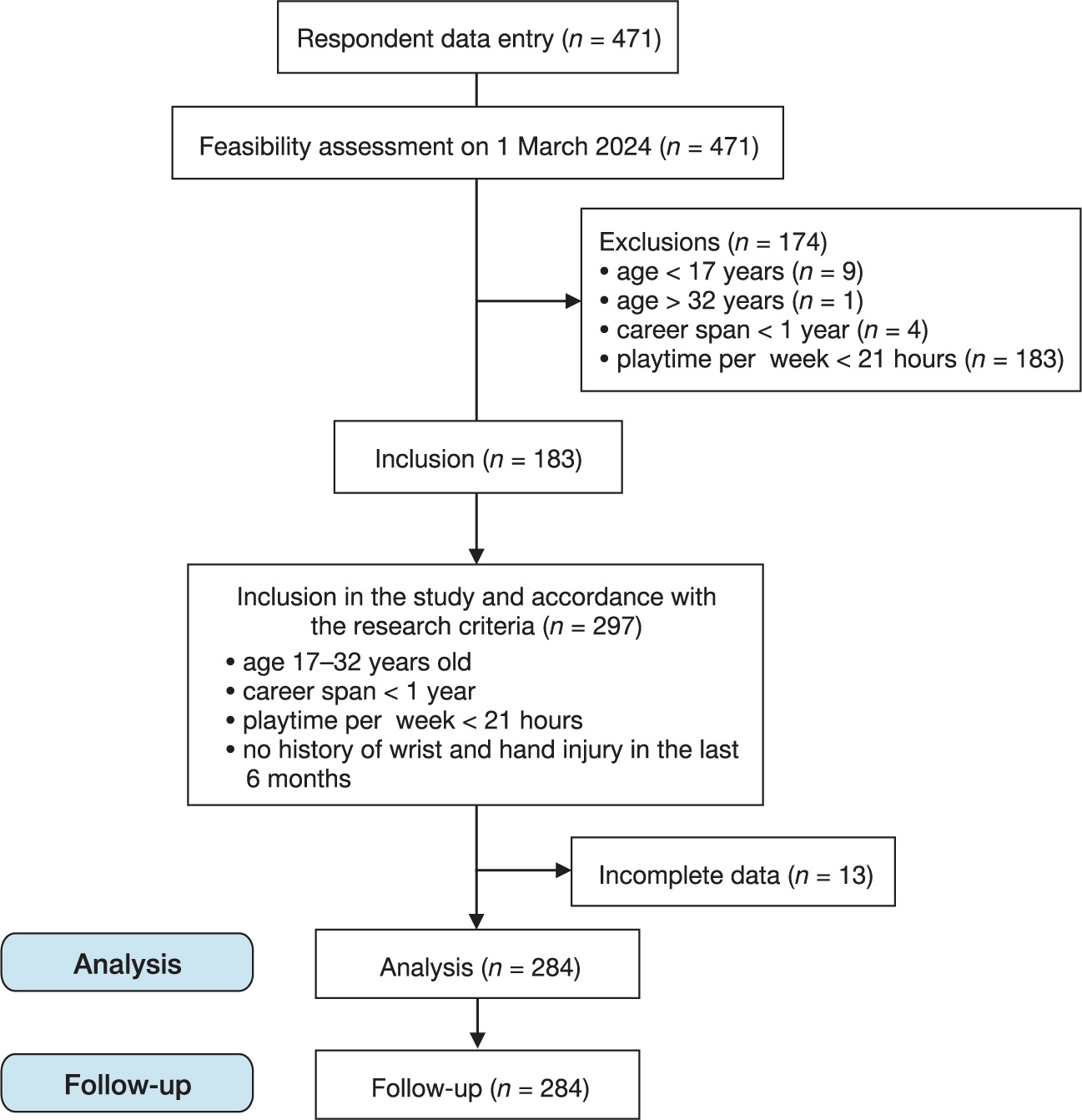
This study used a cross-sectional study approach to determine the contribution of x/independent variables (age, gender identity, player category, playtime, and career span) to y/dependent variables (wrist and hand performance decline) involving a sample of amateur and professional E-sport players/athletes. This research was conducted online through a virtual platform, namely Google Forms, which was distributed in the Central Java and DIY Provinces of Indonesia in the period September 2023 – March 2024 and included population and sample selection followed by data collection and follow-up if there was missing data in the sample. The inclusion criteria of the study were: (1) Active professional or amateur esports players; (2) Willing to be a respondent; (3) Professional esports players with an average playing time of 42 hours of gameplay per week; and (4) Amateur esports players with an average playing time of 21 hours of gameplay per week. Meanwhile, the exclusion criteria for the study were (1) Having a history of injury at a moderate-to-severe level in the wrist and hand; (2) Being in the recovery period after injury to the wrist and hand within ≤ 6 months.
The independent variables/x consisted of gender identity (1 = male; 2 = female), age (1 = 17–20; 2 = 21–24; 3 = 25–28; 4 = 28–32 years), player category (1 = professional; 2 = amateur), playtime (1 = 21–27 h; 2 = 28–34 h; 3 = 35–41 h; 4 = ≥ 42 h), and career span (1 = ≥ 1 year; 2 = > 5 years; 3 = ≥ 10 years), which were measured through a questionnaire developed by the research team. The dependent variable was the decline in wrist and hand function among esports players as measured by the Patient Rated Wrist/Hand Evaluation (PRWHE) (ICC score 0.88–0.92). The PRWHE is a questionnaire consisting of 15 question items consisting of pain subscales and wrist/hand function. Respondents rate their level of wrist/hand pain and functional ability with response options of eleven increasing levels of severity, ranging from 0 to 10 per item. The pain and functional ability subscales are scored from 0 to 50, so the total of both is 0–100. A higher score indicates a worse condition.
The researcher attempted to reduce potential bias by categorising the variables based on previous research and standardised categories. Furthermore, to avoid misperceptions, each research subject was accompanied by a research assistant/enumerator to ensure that the subject did not misunderstand the context of the questions, and that the standardised measurements were tested for validity and reliability before being applied during the research data collection. After the data were collected, researchers recapped and tabulated the data according to the category of data that can be processed to facilitate hypothesis testing. If the data were tabulated and recapitulated, and missing data were found, the research team contacted the sample again to confirm the data entry. If not confirmed, the data were removed from the dataset to reduce potential bias. Data analysis in this study used IBM SPSS Statistics software version 27.0 (IBM Corp., Armonk, New York, USA). Univariate analysis in the study aimed to determine the description of each independent variable – namely age, gender identity, player category, playtime, and career span – on the dependent variable – namely the decline in wrist and hand function among esports players. Data were described through mean, median, minimum, maximum, standard deviation, quartile 1, and quartile 3.
Bivariate analysis was used to determine the correlation of two variables depending on the type of data scale of each variable. This study used the Spearman Test to determine the level of correlation between the independent variable (age, playtime, and career span) and the dependent variable (wrist and hand performance decline); the Kendall-tau correlation test was used to determine the correlation between the independent variable (gender identity and player category) and the dependent variable (wrist and hand performance decline). Furthermore, binary and logistic regression analysis was used to determine the effect of variable x on variable y. A binary regression test was used to determine whether a correlation exists between the independent variables with a nominal data scale. Finally, a logistic regression test determined whether there was a contribution between the independent variable with an ordinal data scale and the dependent variable with an ordinal data scale.
Results
There were 471 esports players who were willing to be respondents to this study by filling out the research questionnaire. After filtering the data, 284 esports players were obtained according to the research inclusion criteria. The data was first tested for normality and found to be abnormally distributed. Descriptive statistics analysis was used to obtain the mean, standard deviation, median, minimum, maximum, quartile 1, and quartile 3 values. Table 1 shows basic information collected from the participants regarding age, gender identity, player category, playtime, career span, and decline in wrist and hand function among the esports players.
Table 1
Statistics on demographic characteristics of respondents
Variable (y): Wrist and hand performance decline
Based on Table 2, the results of the bivariate test using the Kendall-tau test (gender identity and player category) show that only the gender identity variable has a correlation with the decline in wrist and hand function among esports players (p < 0.001). Furthermore, the results of the bivariate test using the Spearman test (age, playtime, and career span) show no correlation with the decline in wrist and hand function among esports players.
Variable (y): Wrist and hand performance decline
In Table 3, the results of the ordinal regression test (age, playtime, and career span) show that age 17–24 years contributed to the decline in wrist and hand function among esports players (p < 0.001). In contrast, the playtime and career span variables do not contribute to the decline in wrist and hand function among esports players. Furthermore, the data from the binary regression test (gender identity and player category) shows that gender identity contributed to the decline in wrist and hand function among esports players (p < 0.001). In contrast, the player category variable did not contribute to the decline in wrist and hand function among esports players.
Table 3
Regression analysis
Discussion
The results of the statistical tests show a low correlation and an 18.5% contribution between gender identity and the decline in wrist and hand function among esports players. The research sample was dominated by male players (96.11%), followed by female players (3.89%). Similarly, a previous study entitled ‘Prevalence and awareness of musculoskeletal injuries associated with competitive gaming in Saudi Arabia’ had 116 participants consisting of 100 (86.2%) men and 16 (13.8%) women [12]. The study revealed that gender identity showed a significant correlation to musculoskeletal injuries. Gender is associated with musculoskeletal disorders in gamers, especially female gamers, who are more at risk of musculoskeletal disorders than male gamers. This is due to several factors. One is that female gamers spend more time playing games for more than 4 hours/day, so they are less physically active [12]. The risk of injury is higher for women than men due to the difference in grip strength between the two. Men generally have higher grip strength and better resistance to muscle fatigue than women [13].
Furthermore, no correlation was found between age and the decline in wrist and hand function among esports players. Although the correlation analysis did not show a contribution between the two variables, this study shows that age 17–24 years has a 1.8% contribution to the decline in wrist and hand function among esports players. In Odebiyi and Okafor’s research [14], it was explained that occupational musculoskeletal injuries result from a complex interaction of various factors. These factors can be categorised into three main groups. The first is physical factors such as repetitive movements and unergonomic postures, the second, individual factors such as age, gender, and level of physical activity, and the third, psychosocial factors such as work demands and social support. The interaction between these factors can increase the risk of musculoskeletal disorders [14]. Therefore, age alone does not significantly contribute to occupational musculoskeletal injuries [15].
On the other hand, no correlation was found between the player category (professional or amateur) and the decline in wrist and hand function among esports players. Jasmine’s [16] research explained that professional esports player teams have structured and intensive training, with a training duration of 6–8 hours/day, 5 days/week. Professional esports players not only practice playing games but also do regular physical exercise to maintain body fitness and minimise the risk of injury. Professional esports teams like ONIC even have a physical coach to maximise the performance of their players [16]. Unlike professional esports players, amateur players generally do not aim to improve their gaming skills consistently and are less focused on competition. Therefore, amateur esports players tend to have less gaming time and less risk of injury [5].
There was also no correlation between career span and the decline in wrist and hand function among esports players. This finding is in line with previous research, which shows that career span has no contribution to injuries experienced by esports players. This makes sense because the careers of esports players, especially professional players, are relatively short. Generally, professional players have a career duration of around 6 years with an age range of 18–24 years. In addition, the intensity of playing esports is relatively lower than for other sports, such as basketball and badminton, so it only causes minor injuries [17]. The esports profession is interesting but not recommended as a long-term career due to the limited post-esports career opportunities in fields such as training and broadcasting, and the public perception that it is not yet a serious career [18].
Like the player category and career span, the playtime also showed no correlation with the decline in wrist and hand function among esports players. The results of this study are not in line with the results of Clements et al. [19], who showed that esports players who practice more than 5 hours/day have a 3 × higher risk of injury than esports players who practice less than 5 hours/day. Furthermore, Clements et al. [19] also explained that injuries to esports players are more common due to the continuous and excessive play compared to intermittent play over a long time [19]. In this study, not all players played games daily, but 12.7% of players played intermittently in each session. A study conducted in Batu City mentioned that the knowledge possessed by athletes will be beneficial for them in understanding the injuries that occur and how to overcome them [20]. In this study, 52.8% of the esports players knew what treatment to perform when they experienced pain in the wrist and hand due to playing games, while 47.2% of players did not know. With this level of knowledge, it can reduce the risk of injury experienced by the respondents in this study.
To evaluate the risk factors for wrist and hand function decline among esports players, covering the relevant activities performed, whether gaming, practicing, competing, or leisure, is crucial. This is because most risk factors for a decline in wrist and hand function can occur in these situations. In addition, ergonomic factors such as uncomfortable postures, static body positions, and repetitive hand movements while playing games are closely linked to musculoskeletal injuries in players. These ergonomic factors interact with other risk factors, synergistically affecting the musculoskeletal system rather than focusing on a single risk factor [21]. However, further research is needed to determine rehabilitation programs and to prevent wrist and hand functional decline in esports players. The findings of this study can be used as a reference or basis for research, especially regarding risk factors for wrist and hand function decline among esports players. Health workers, physiotherapists, and esports players can pay attention to the risk factors to maintain the functional ability of the wrist and hand in esports players to ensure that they remain optimal.
Limitations
Several limitations should be considered when interpreting the results of this study. First, the respondents’ lack of understanding of the questionnaire resulted in biased data. Second, most respondents were esports players who use smartphones, so the data is less varied. Third, the study is gender-biased, as the majority was conducted on male respondents due to the lack of female respondents. Fourth, this research has yet to involve in-depth measurement of ergonomic aspects using motion analysis software technology such as Kinovea to acquire more precise results.
Conclusions
The study results found that playtime, career span, and player category have no correlation or contribution to the decline in wrist and hand function among esports players. In contrast, the age category of 17–24 years has a 1.8% contribution to the decline in wrist and hand function among esports players. In addition, gender identity has been proven to correlate 0.321 and contribute 18.5% to the decline in wrist and hand function among esports players.